

If you’ve been feeling wired but tired, you’re not imagining it. Modern life has a way of keeping your stress response switched on long after the stressful bit has passed. So it’s no surprise that adaptogens have become one of the most searched-for corners of the supplement world.
Two names come up more than any other: ashwagandha and rhodiola. They get lumped together a lot, and they do share a job. But they don’t feel the same, and choosing between them is easier once you know what each one actually does.
Here’s the honest, science-led breakdown of Ashwagandha vs Rhodiola for Stress and how to choose the right one for you.
First, what’s an adaptogen?
An adaptogen is a plant that’s traditionally used to help your body “adapt” to stress and find its balance again. The idea has been around for centuries in traditional practices, and researchers have spent the last few decades trying to understand how it works.
When you’re under pressure, your body leans on something called the HPA axis (the hypothalamus, pituitary gland and adrenal glands). This is the system that releases cortisol, your main stress hormone. Cortisol is useful in short bursts. The trouble starts when it stays high for weeks on end, which is when you might notice poor sleep, a short fuse, cravings and that running on empty feeling.
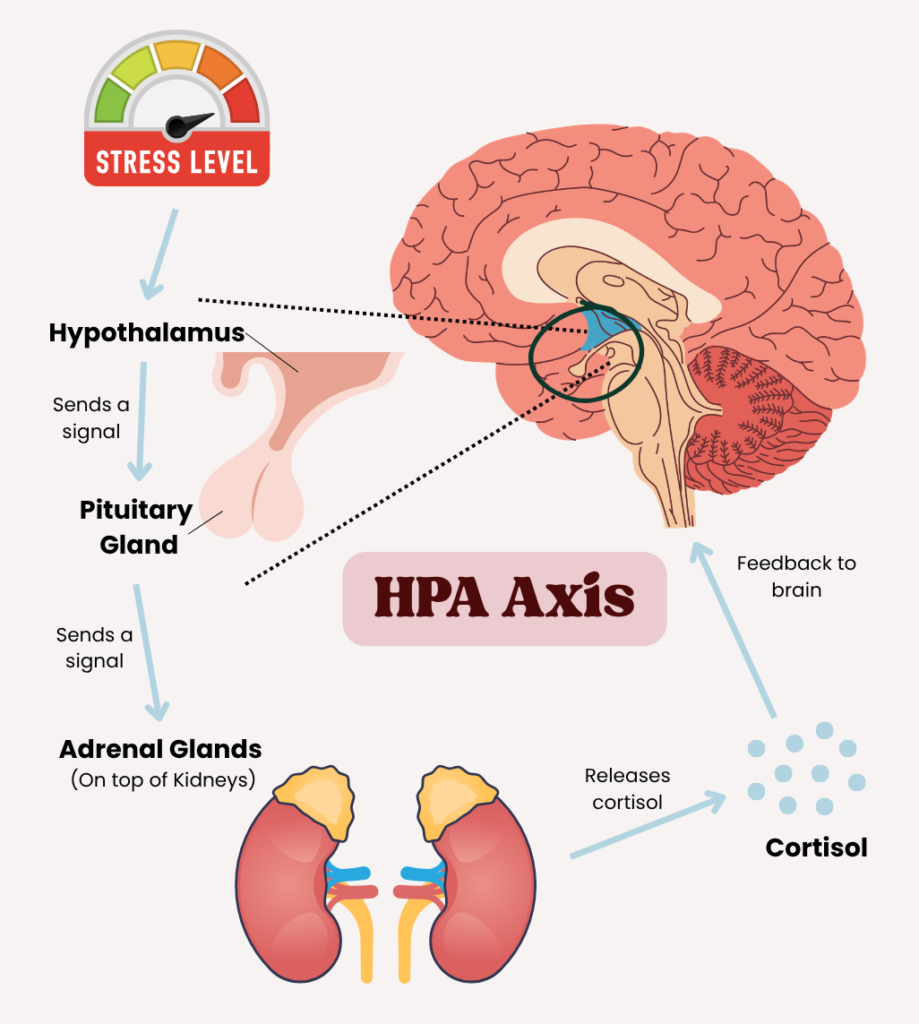
When stress keeps this loop switched on, cortisol stays high, and that’s when you start to feel it. Adaptogens like ashwagandha and rhodiola are thought to help the body settle this response back down, gently, rather than forcing it in one direction. That’s the theory behind both. Where they differ is in how that balance tends to feel.
Ashwagandha: the calm one
Ashwagandha (its botanical name is Withania somnifera) is the adaptogen most people associate with calm. It’s traditionally used to take the edge off, quieten a busy mind and support better rest.
The research is where it gets interesting. In one randomised, double-blind, placebo-controlled trial, adults with a history of chronic stress who took a concentrated ashwagandha root extract reported meaningfully lower stress scores after 60 days, alongside lower serum cortisol, compared with those on a placebo [1]. A separate trial in stressed adults found a similar pattern, with reduced cortisol and improvements in perceived stress [2]. A later study using a standardised extract reported lower anxiety scores and lower morning cortisol again [3].
None of this means ashwagandha is a magic switch, and no supplement is. But the direction of the evidence helps explain why people describe it as grounding rather than sedating.
That calm quality is also why one of the most common questions we get is whether ashwagandha makes you sleepy. It doesn’t knock you out like a sleeping tablet. Most people find it simply makes winding down feel a little easier, which is handy in the evening. If sleep is your main reason for looking, our guide on ashwagandha for sleep goes deeper, and if it’s the cortisol angle you’re curious about, we’ve written about whether ashwagandha lowers cortisol too. You can also read up on the plant itself on our ashwagandha ingredient page.
Ashwagandha tends to suit you if: you feel tense, over-stimulated or “switched on” when you’d rather be switching off, and calmer evenings and better sleep are your goal.
Rhodiola: the energising one
Rhodiola (Rhodiola rosea) plays a different tune. It’s the adaptogen traditionally used for tiredness, low stamina and mental fatigue, the kind that hits when you’re stressed and stretched thin rather than wound up.
The studies reflect that. In a classic trial, young doctors working demanding night shifts took a standardised rhodiola extract and showed a measurable improvement in mental performance and a lower fatigue index compared with placebo [4]. In another randomised trial, people with stress-related fatigue and burnout who took rhodiola reported less fatigue and better concentration, along with a change in their morning cortisol response [5].
So while ashwagandha tends to pull you towards calm, rhodiola tends to lift you out of the fog. People often describe it as clearing mental tiredness rather than giving a caffeine-style buzz.
That makes it a very different tool. If your stress shows up as low energy, poor focus and dragging yourself through the afternoon, rhodiola is the one that gets the attention. It’s worth knowing that rhodiola isn’t part of the Supp range, so this section is here to help you compare fairly.
Rhodiola tends to suit you if: stress leaves you flat and foggy, and daytime energy and focus matter more to you than winding down.
Ashwagandha vs rhodiola: the honest comparison
| Ashwagandha | Rhodiola | |
|---|---|---|
| The feeling | Calm, grounded, settled | Alert, clear, less foggy |
| Best known for | Stress, tension, sleep | Mental fatigue, focus, stamina |
| Usually taken | Evening, or twice daily | Morning or early afternoon |
| How it may work | Supporting a calmer cortisol response | Easing mental fatigue and the stress response |
| Good match if | You feel wired and want to wind down | You feel drained and want a lift |
The key thing to notice is that neither is “better.” They’re built for different problems. Picking the right one is really about being honest with yourself about how your stress actually feels.
So which one should you choose?
Try this quick gut check.
If your evenings are the hard part, if your mind races when your head hits the pillow, or if you’d describe yourself as tense, ashwagandha is the natural starting point.
If your mornings and afternoons are the struggle, if you feel foggy, flat and low on drive, rhodiola is the one to look at first.
And if you genuinely can’t tell? Start with the calming route. A lot of tired all day actually traces back to poor sleep and a stress response that never fully switches off, so getting your evenings and rest in order often solves more than people expect. It’s also worth mentioning that some people pair calming and focus-supporting ingredients depending on the time of day, which is why a few reach for something like our Lion’s Mane Gummies for daytime clarity alongside an evening wind-down.
Can you take ashwagandha and rhodiola together?
Yes, plenty of people do, and the usual approach is to split them by time of day rather than take both at once. Rhodiola in the morning for focus and energy, ashwagandha in the evening to wind down. That way each one is doing its job when you actually need it.
A few sensible notes. Start with one at a time so you can tell what’s doing what. Give it a fair run of a few weeks, since adaptogens tend to build gradually rather than hit instantly. And if you take any medication or you’re pregnant or breastfeeding, check with your GP or pharmacist first, because botanicals can interact with certain medicines.
The bit no supplement can do for you
Adaptogens work best as one part of a wider routine, not a rescue remedy. If your stress response is stuck on high, the daily basics move the needle more than any capsule.
A few small things that genuinely help:
- Breathe on purpose. Slow, controlled breathing is one of the fastest ways to signal safety to your nervous system. Our walkthrough of alternate nostril breathing (nadi shodhana) is a simple two-minute reset you can do anywhere.
- Move gently. You don’t need to punish yourself. A short walk or an easy mobility session counts.
- Protect your sleep. It’s the foundation everything else sits on.
If you want more, our roundup of simple habits to reduce stress and feel calmer pulls the practical ones together.
How we do ashwagandha at Supp
If ashwagandha sounds like your match, quality is where the real difference lies, and it’s where a lot of products quietly cut corners.
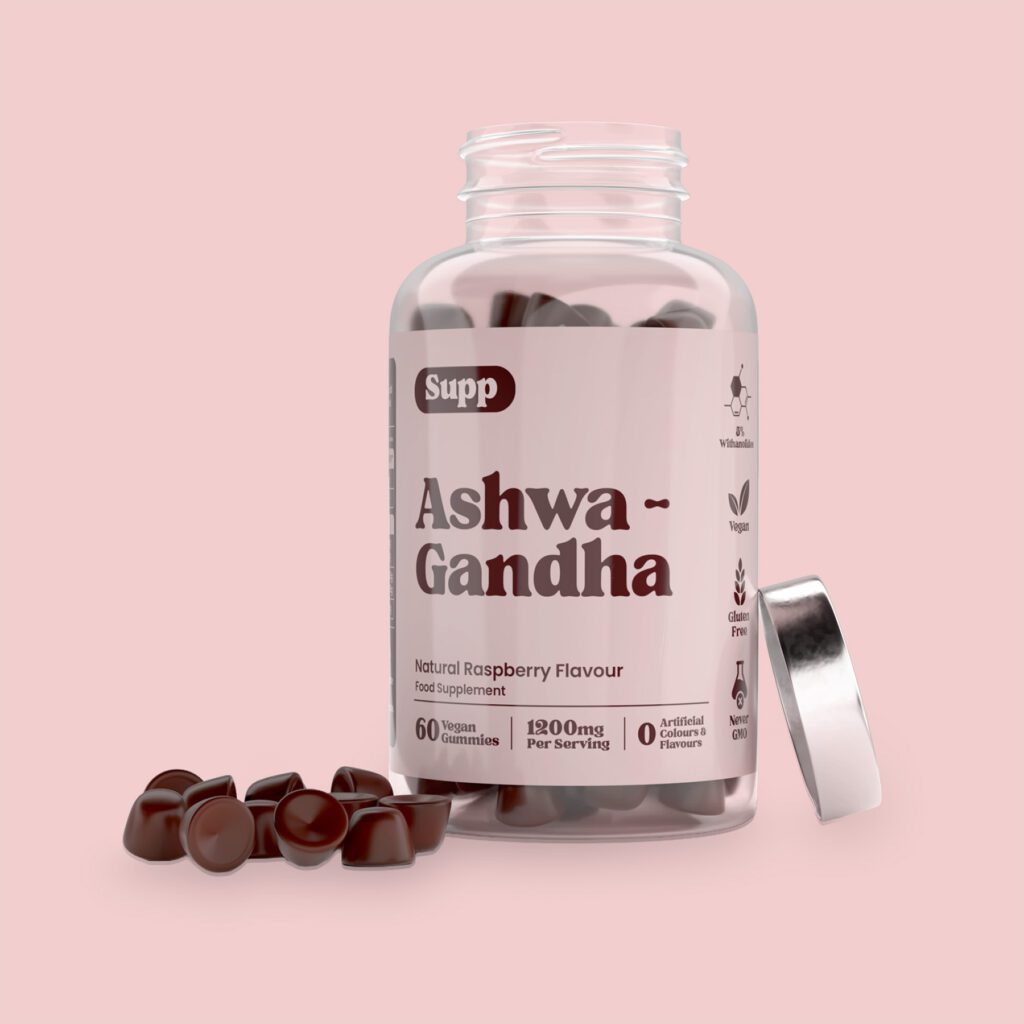
Our Ashwagandha Gummies are made in the UK in a GMP-certified facility, with a clear, honest label so you know exactly what you’re taking and how much. No hidden blends, no mystery “proprietary” mixes that hide the real doses, and nothing on the label you can’t pronounce or explain.
We built them this way because we were tired of the same things you probably are: vague claims and formulas that seem designed to impress rather than to help. You deserve to know what’s in the bottle and why every ingredient earned its place.
Whichever route you take, calm or energy, the goal is the same. Feeling a bit more like yourself, one good day at a time.
This article is for general information and isn’t medical advice. Supplements are not a substitute for a balanced diet and healthy lifestyle. If you’re pregnant, breastfeeding, taking medication or managing a health condition, always consult your GP or a qualified health practitioner before use.
References
- Chandrasekhar K, Kapoor J, Anishetty S. 2012. A prospective, randomized double-blind, placebo-controlled study of safety and efficacy of a high-concentration full-spectrum extract of ashwagandha root in reducing stress and anxiety in adults. Indian Journal of Psychological Medicine. https://pubmed.ncbi.nlm.nih.gov/23439798/
- Choudhary D, Bhattacharyya S, Joshi K. 2016. Body weight management in adults under chronic stress through treatment with ashwagandha root extract: a double-blind, randomized, placebo-controlled trial. Journal of Evidence-Based Complementary & Alternative Medicine. https://pubmed.ncbi.nlm.nih.gov/27055824/
- Lopresti AL, Smith SJ, Malvi H, Kodgule R. 2019. An investigation into the stress-relieving and pharmacological actions of an ashwagandha (Withania somnifera) extract: a randomized, double-blind, placebo-controlled study. Medicine (Baltimore). https://pubmed.ncbi.nlm.nih.gov/31517876/
- Darbinyan V, Kteyan A, Panossian A, Gabrielian E, Wikman G, Wagner H. 2000. Rhodiola rosea in stress-induced fatigue: a double-blind cross-over study of a standardized extract SHR-5 on the mental performance of healthy physicians during night duty. Phytomedicine. https://pubmed.ncbi.nlm.nih.gov/11081987/
- Olsson EM, von Schéele B, Panossian AG. 2008. A randomised, double-blind, placebo-controlled, parallel-group study of the standardised extract SHR-5 of the roots of Rhodiola rosea in the treatment of subjects with stress-related fatigue. Planta Medica. https://pubmed.ncbi.nlm.nih.gov/19016404/