




We often think injuries happen from one bad movement, but it’s usually more about load vs capacity.
Every tissue in the body has a limit to how much force it can tolerate. If the load placed on it exceeds its current capacity, damage can occur. That’s where the stress–strain curve comes in.
A quick look at why injuries really happen:
Before we get into the curve, it helps to know what’s underneath the skin doing the work.
A muscle isn’t one solid block of tissue. As you can see in the diagram below, it’s a bundle of smaller units. Each muscle is made up of muscle fascicles, and each fascicle is itself a bundle of individual muscle fibres. Those fibres are wrapped in connective tissue, fed by blood vessels, controlled by nerves, and anchored to bone by tendons. Every one of these layers contributes to how the muscle handles force.
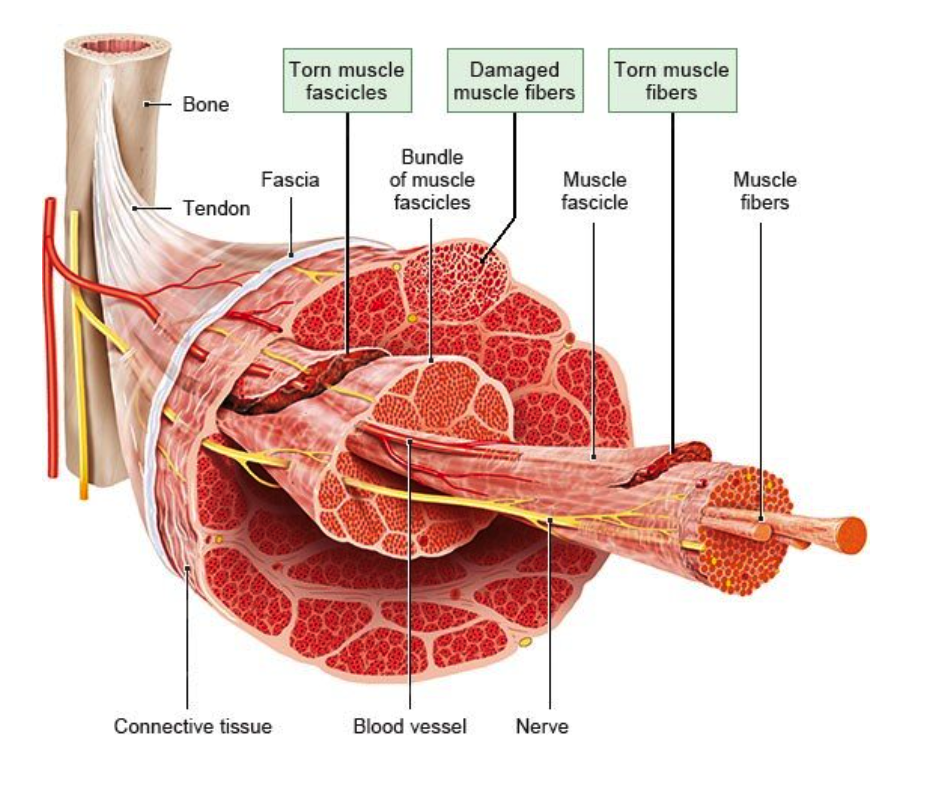
^ The structure of a muscle, from bone and tendon down to individual fibres. Load passes through all of these layers, and capacity depends on how well each one can tolerate it.
So what do we mean by Load vs Capacity?
Load is the force being placed on those structures. That could be the weight on a barbell, the impact of your foot striking the ground when you run, the pull on a tendon during a jump, or simply your own bodyweight as you move through a workout. Every movement creates load somewhere in the body.
Capacity is how much of that force the tissue can currently handle without breaking down. A well-trained Achilles tendon has more capacity than an untrained one. A back that’s been gradually built up to lifting heavy has far more capacity than one that’s spent the last twelve months on the sofa. Capacity is essentially the tissue’s tolerance level at this moment in time.
When load sits within capacity, the tissue adapts and gets a little stronger. When load creeps above capacity, that’s when problems start. And that’s exactly what the stress-strain curve helps us understand.
The Stress-Strain Curve
Toe region
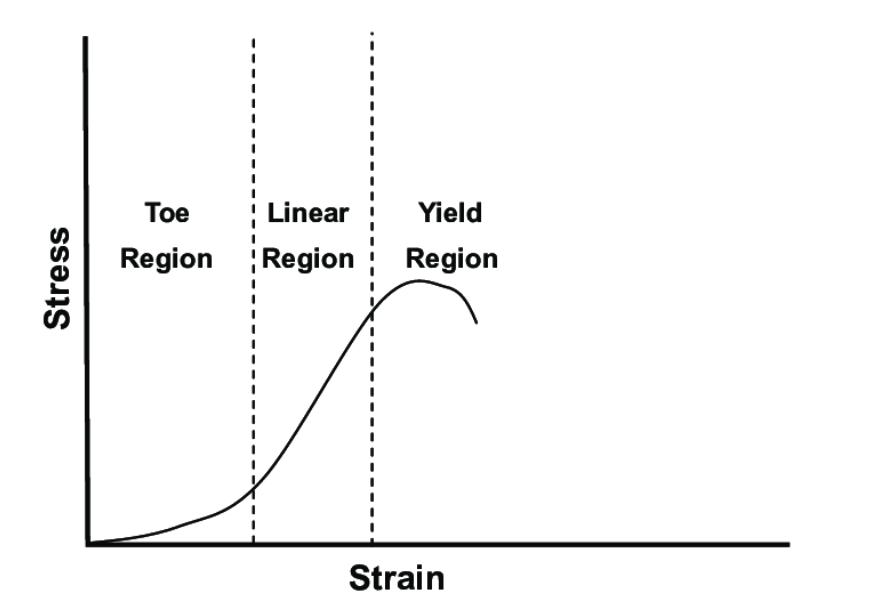
At the beginning of the curve is the toe region. Here, collagen fibres are slightly crimped and begin to straighten out as load is applied. Small amounts of stretch occur, but the tissue can still fully return to normal once the load is removed.
Elastic region
Next is the elastic region (linear region). In this phase, the tissue deforms under load but still recoils back to its original shape. This is where healthy loading and training often occur, the tissue is being challenged, but not damaged.
Plastic region
As force continues to increase, the tissue enters the plastic region (yield region). Here, microscopic failure begins to occur. Collagen fibres start to break down, and the tissue no longer fully returns to its previous state. This is where minor strains, irritation, or overload injuries can begin developing. If you’ve ever felt a niggle that lingers a little longer than expected, this is often where it sits.
The failure point
If load keeps increasing beyond the tissue’s tolerance, it reaches the failure point. This is where significant tearing or rupture can occur because the tissue can no longer handle the stress being placed upon it.
Capacity Isn’t Fixed
The important part? Capacity isn’t fixed.
Through progressive training, tissues can adapt to tolerate greater load over time:
- Strength training
- Plyometric work
- Tendon loading
- Movement control and conditioning
Each of these builds the tissue’s tolerance in slightly different ways, but the principle is the same. Stress the tissue, recover, adapt, repeat. Over weeks and months, that’s what raises your capacity ceiling.
Rehab and injury prevention aren’t about avoiding load completely, they’re about exposing the body to the right amount of load at the right time.
And it’s not just the training side that matters. Recovery is half the equation. If you’re loading hard but never giving tissues the chance to adapt, you’re more likely to drift into that plastic region where overload starts to creep in. Sleep, nutrition and sensible programming all sit alongside the training itself.
Understanding load vs capacity is key to understanding why injuries happen and how we can reduce the risk of them.
You can explore more of my workouts here if you’d like to start building capacity in a structured way.
References
- https://www.informedhealth.org/muscle-strains
- https://www.researchgate.net/publication/257076649_Recent_Advancements_in_Ligament_Replacement
Disclaimer:
This blog is for general information and isn’t a substitute for medical advice. If you’re currently injured, in pain, or unsure about loading a particular area, please speak to a qualified physiotherapist or healthcare professional before starting any new training programme.