

If you’ve searched for a turmeric supplement recently, you’ll know the problem. Hundreds of products, all claiming to be the most potent, the most bioavailable, the most researched. Most of them look identical on the outside.
The truth is, turmeric supplements vary enormously in quality. What’s on the front of the label often tells you very little about what’s actually inside. And because most people don’t know what to look for, a lot of products get away with looking the part without doing much at all.
This guide explains what genuinely separates a good turmeric supplement from one that’s unlikely to do much for you.
Why Whole Turmeric Root Isn’t Enough
Turmeric is a spice. It’s been used in cooking for thousands of years and has a well-established history in traditional medicine, particularly in Ayurvedic practice. The active compounds responsible for most of its studied health benefits are called curcuminoids, the most important of which is curcumin.
Here’s the issue. Whole turmeric root contains only around 2-5% curcumin by weight. A supplement made from plain dried turmeric root, even at a large dose, delivers very little of the compound that research actually studies.
This is why the form of turmeric in a supplement matters far more than the headline dose. A 500mg standardised turmeric extract providing 95% curcuminoids is a very different product to 500mg of dried turmeric root powder. They might look identical on a label if the manufacturer isn’t being transparent about what’s inside.
What To Look For In A Turmeric Supplement
1. Standardised extract, not whole root powder
The best turmeric supplements use a concentrated, standardised extract rather than plain turmeric root powder. Standardised means the product guarantees a specific percentage of active curcuminoids in every capsule, regardless of natural variation in the raw ingredient.
Look for a product that clearly states its curcuminoid content, ideally 95% curcuminoids from a concentrated extract. If a label only mentions “turmeric root” or gives a large dose like 4,000mg without specifying what the extract provides, treat that as a red flag.
2. Black pepper extract (piperine) for absorption
This is arguably the most important factor of all, and it’s one that many cheaper supplements skip entirely.
Curcumin has notoriously poor bioavailability on its own. It’s poorly absorbed, metabolises quickly, and is eliminated from the body rapidly. In isolation, very little of what you take actually reaches the bloodstream at meaningful levels.
Black pepper extract, specifically the alkaloid piperine, changes that significantly. Research has shown that piperine can increase the bioavailability of curcumin by up to 2000% by inhibiting certain metabolic enzymes that would otherwise break it down before it can be absorbed.
If a turmeric supplement doesn’t include black pepper extract, or an equivalent bioavailability enhancer, you’re likely getting a fraction of the benefit. We’ve covered the science behind this in more detail in our article on why you need black pepper with turmeric.
3. A meaningful dose
Most of the research on turmeric and curcumin uses doses in the range of 500mg to 1,000mg of standardised extract per day. Below this, it’s difficult to reach the levels associated with the benefits seen in studies. Above this, you’re unlikely to see additional benefit for general wellness use.
Check the label for extract amount, not just the whole root equivalent. Some products inflate their apparent dose by listing the whole root equivalent (e.g. “equivalent to 10,000mg turmeric root”) while the actual extract amount is much smaller. The extract amount is what matters.
4. Transparent labelling
A trustworthy supplement tells you exactly what’s in it, in plain language. Every active ingredient should be listed with its specific amount. If you see vague terms like “proprietary blend” or the label lists turmeric without specifying the curcuminoid content, move on.
This isn’t a minor issue. A 2025 market assessment of 125 turmeric supplements sold across the UK, USA, Australia, Germany, and India found that over a third failed to disclose their active curcuminoid content at all. The researchers called for standardised labelling and clear dosage guidelines, noting that without this information, consumers have no reliable way to compare products or know whether they’re taking an effective dose.
Transparency also extends to excipients. Every ingredient in a capsule, including fillers, flow agents, and capsule materials, should be listed. A brand that’s confident in its formula has nothing to hide.
5. UK made and GMP certified
Manufacturing standards vary significantly between countries. GMP (Good Manufacturing Practice) certification means a facility has been independently audited against defined quality and safety standards. In the UK, GMP-certified production also means your supplement is subject to Food Standards Agency oversight.
This matters because it gives you confidence that what’s on the label is actually in the capsule, at the right dose, without contamination. It’s the difference between a supplement you can trust and one you’re taking on faith.
What To Avoid
A few things worth watching out for when comparing turmeric supplements:
- Large headline doses with no extract information. A 10,000mg turmeric root claim sounds impressive. A 500mg standardised extract delivering 475mg curcuminoids is actually more potent.
- No black pepper. Without piperine, much of the curcumin you’re taking is likely metabolised before it can do anything useful.
- Unnecessary fillers and additives. Some products include bulking agents, artificial colours, or unnecessary excipients. None of these add anything for the person taking the supplement.
- No manufacturing information. If a brand doesn’t tell you where or how their supplements are made, that’s a meaningful omission.
- Wild promises. Turmeric is a well-researched botanical with genuine evidence behind it. Any brand claiming it will “cure” or “fix” specific health conditions is overstating what the science supports and likely breaking UK advertising law in the process.
What Does Turmeric Support?
Turmeric extract, at effective doses and with proper absorption support, has been studied for a range of everyday health areas. The research is strongest around joint health, where curcumin’s antioxidant properties contribute to normal joint function and help protect cells from oxidative stress. It’s also been studied for its role in supporting normal digestion, circulation, and immune function.
It’s worth being clear about what turmeric supplements are and aren’t. They’re not a treatment for arthritis or any other medical condition. They’re a daily supplement that, as part of a healthy lifestyle, contributes to normal function in several areas of the body. If you’re looking for a deeper look at the research, our article on turmeric benefits and what the research says covers this in detail.
What We Use At Supp
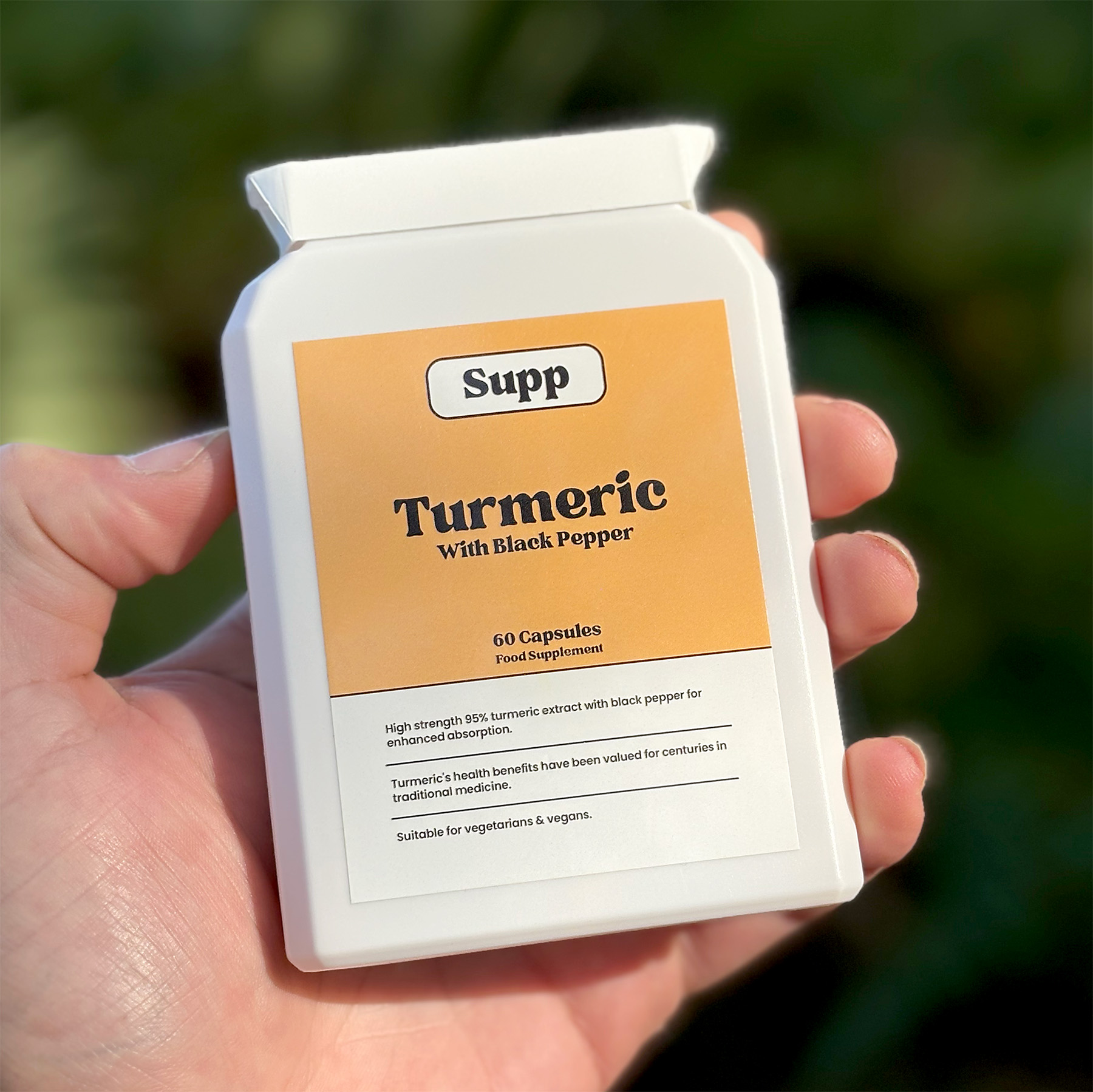
Our Turmeric Extract with Black Pepper is built around the criteria above. Each capsule delivers 500mg of standardised turmeric extract (Curcuma longa), providing 475mg of curcuminoids, combined with black pepper extract to support proper absorption. No unnecessary fillers, no hidden blends, and no inflated whole root claims.
It’s made in the UK in GMP-certified, BRCGS AA-rated facilities. Suitable for vegans and vegetarians. One to three capsules a day, with food.
You can find the full ingredient breakdown and product details at supp.store/bones-joints/turmeric-extract-with-black-pepper/.

Frequently asked questions
What is the best form of turmeric supplement to take?
A standardised turmeric extract, providing a guaranteed curcuminoid content, is significantly more reliable than whole turmeric root powder. Always look for a product that combines this with black pepper extract to support proper absorption.
How much turmeric should I take per day?
Most research uses doses of 500mg to 1,000mg of standardised extract per day. For general wellness use, 500mg of a high-curcuminoid extract taken with black pepper is a reasonable and well-supported daily dose.
Does turmeric actually work as a supplement?
The evidence supporting turmeric, specifically curcumin, is meaningful but depends heavily on the quality of the product and whether absorption has been addressed. A well-formulated turmeric supplement with black pepper extract is likely to behave very differently to a basic whole root powder at the same dose.
Can I take turmeric every day?
Yes, daily use is how most people incorporate it. Turmeric is generally well tolerated at recommended doses. If you are taking blood-thinning medication, have gallbladder disease, or are pregnant or breastfeeding, speak to your GP before starting.
Is curcumin the same as turmeric?
Not exactly. Turmeric is the plant. Curcumin is the primary active compound within turmeric, and one of a group of compounds called curcuminoids. When people talk about the health benefits of turmeric, they’re largely referring to the effects of curcumin and curcuminoids specifically.
When should I take a turmeric supplement?
Take it with food, which helps absorption. Morning with breakfast works well for most people and makes it easier to stay consistent. If you take it in capsule form with black pepper extract included, you don’t need to add anything else.
Scientific resources & clinical studies
Turmeric supplement labelling inconsistencies across five countries
A 2025 market assessment of 125 turmeric supplements sold across the UK, USA, Australia, Germany, and India. Found that over a third failed to disclose active curcuminoid content, and highlighted significant regulatory inconsistencies. The study calls for transparent labelling, standardised dosage guidelines, and greater understanding of curcumin’s metabolic profile. Read the study here
Disclaimer
Food supplements should not be used as a substitute for a varied, balanced diet and a healthy lifestyle.
If you are pregnant, breastfeeding, taking medication, or have a medical condition, consult your doctor before use. Always consult your healthcare practitioner before taking nutritional supplements.