

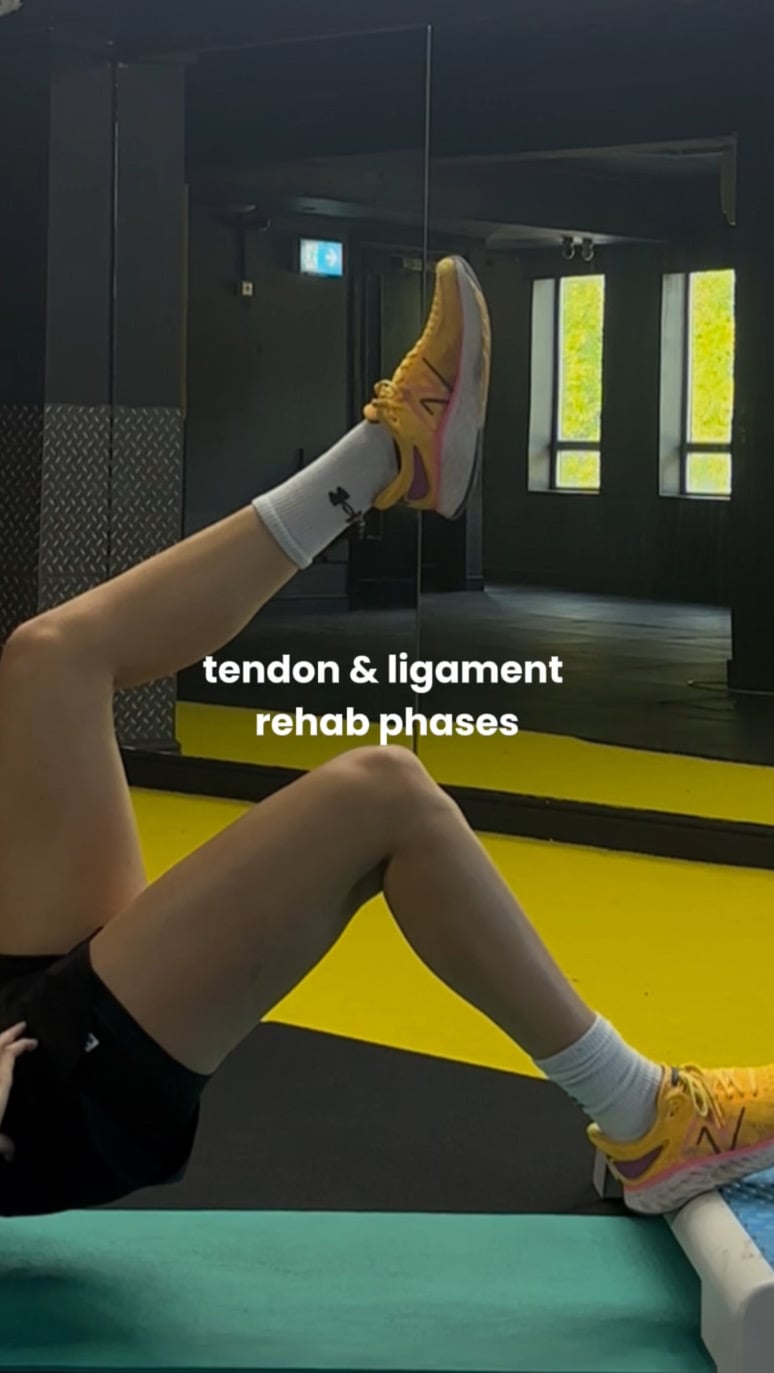
When people hear the word ‘rehab’, they often picture rest, stretching, or avoiding movement altogether. It’s one of the most common misunderstandings we come across, and it can leave people sitting still when their tissue actually needs the opposite. Successful tendon and ligament rehab is really just structured training. The exercises simply change depending on what stage of healing the tissue is in.
Last week we looked at how tendons and ligaments actually heal, walking through what happens at a cellular level across the inflammatory, proliferative and remodelling phases. This piece is the practical other half of that. If the last article explained why healing happens the way it does, this one shows you what to actually do in your training during each of those phases.
Each phase has a different goal. Early on, we focus on protecting the tissue while keeping the body moving. As healing progresses, exercises become more strength-focused, before eventually transitioning into higher-level gym work and explosive movements. Here’s how rehab can look through each phase of healing.
Prefer to watch? Maddie talks through how to train each phase in the video below:
Inflammatory Phase: Restore Movement Without Overloading
The inflammatory phase is the body’s immediate response to injury. Pain, swelling, stiffness, and reduced movement are common here, which is why the goal isn’t to “train hard”, but to keep the area moving without irritating the tissue further. This phase lines up with the inflammatory stage we covered in the tendon and ligament healing guide, where reduced load tolerance is all part of the body’s early repair response.
This phase is all about gentle activation and controlled loading. Complete rest can actually lead to more stiffness and weakness, so introducing low-level movement early can help maintain muscle function and improve circulation around the injured area.
Example Exercises
Isometric Bridge Holds: A simple way to maintain posterior chain activation while keeping load controlled. Focus on squeezing the glutes and holding a steady position rather than pushing for intensity.
Wall Sits: Great for introducing lower-body loading without excessive joint movement. Isometrics can also help reduce pain sensitivity during early rehab stages.
Controlled Mobility: Work Gentle ankle rocks, knee bends, or shoulder mobility drills help maintain range of motion and reduce stiffness without placing too much stress on healing tissue.
Passive or Assisted Range of Motion: Using support or assistance to move the joint through a comfortable range can help restore movement while protecting the injured structure.
The goal during this stage is simple – keep the body moving while allowing the tissue to settle.
Proliferation Phase: Rebuild Strength and Capacity
As healing progresses, the body starts laying down new collagen fibres. This is where rehab begins shifting from protection towards rebuilding. The tissue now needs progressive loading to help those fibres become stronger and more organised.
This stage often feels better symptom-wise, but the tissue is still vulnerable, which is why control is key. Exercises become more structured, but movement quality still matters more than intensity.
Example Exercises
Bodyweight Squats: A controlled way to reintroduce strength and confidence through full movement patterns.
Resistance Band Exercises: Bands allow gradual loading while keeping movements controlled and stable. Great for tendons and ligaments that aren’t ready for heavier resistance yet.
Step-Ups: Introduce single-leg control and begin challenging balance and coordination while rebuilding lower-body strength.
Light Machine-Based Strength Work: Exercises such as leg press, hamstring curl, or calf raises allow tissues to tolerate more load in a stable environment.
Tempo-Based Movements: Slowing exercises down increases time under tension and improves tissue control without needing heavy weights.
The aim here is to gradually rebuild tissue capacity and reintroduce strength through controlled movement.
Remodelling Phase: Return to Strength, Power, and Performance
The remodelling phase is where rehab starts to resemble normal training again. The tissue is becoming stronger and more capable of handling force, meaning exercises can become heavier, faster, and more demanding.
At this point, the focus shifts towards preparing the body for real-world movement, whether that’s sport, running, gym performance, or simply returning to normal activity confidently.
Example Exercises
Heavy Strength Work: Exercises such as squats, deadlifts, split squats, and Romanian deadlifts help improve the tissue’s ability to tolerate higher loads.
Eccentric Loading: Slow lowering phases place greater demand through the tendon or ligament, helping improve strength and resilience.
Single-Leg Exercises: Movements like single-leg RDLs, lunges, and step-downs improve stability, balance, and control under load.
Plyometrics: Skipping, hopping, jumping, and bounding drills help reintroduce force absorption and explosive movement patterns.
Change of Direction and Dynamic Drills: For athletes especially, the tissue needs exposure to rotation, acceleration, and deceleration before returning fully to sport.
The goal in this phase isn’t just healing, it’s preparing the tissue to handle the demands of life and training again.
Too much load too early can aggravate symptoms, but too little load for too long can leave tissues weak and underprepared. The key is progressing exercises at the right time, in the right way.
Healing isn’t about avoiding movement. It’s about using movement strategically so the body can adapt, rebuild, and come back stronger. If you want to understand the biology driving all of this, head back to our guide on how tendons and ligaments heal, and if you’re working through an injury, a qualified physiotherapist can guide you on what’s appropriate for your specific situation.
Disclaimer:
This article is for general educational purposes and reflects current understanding of how to approach tendon and ligament rehab. It isn’t a substitute for personalised medical advice, diagnosis or treatment. Everyone heals at a different pace, and the right exercises at the right time will depend on your specific injury. If you’re recovering from an injury or have ongoing pain, please consult a qualified physiotherapist, GP or healthcare professional who can assess your individual situation.