


Urban Wellness
A data-led look at where stress is rising in the UK and what we can do about it today.
This analysis highlights pockets of high stress across the UK, with northern urban areas consistently under pressure. Blackburn is flagged as a leading hotspot in our analysis, with persistent indicators tied to mental health prevalence and deprivation.
Our research combined data from the NHS, ONS, Google Trends, and national wellbeing surveys to rank 20 UK cities by their overall stress score. Each city’s ranking reflects a blend of mental health prevalence, work-related stress, search behaviour for stress and anxiety, and personal well-being indicators.

Explore the Urban Wellness Map
Tap a city to see data about stress & mental health. See the list of cities below.
The UK’s Most Stressed Cities
Each city is given a Stress Score from 0 to 100. A higher score means higher observed stress signals in that city. We build this score from four data sources, normalised per head of population so that places of different sizes are comparable, then scaled to a 100-point index.
The data we collected reveals where stress is hitting the hardest across the UK. From financial pressures to disrupted sleep, the findings highlight a growing need to support both mental and physical wellbeing, especially among young adults.
How we calculated the stress score
For each data source we created a per-capita or proportion metric where applicable, standardised it to a 0–100 sub-score, and then computed the Stress Score = average of the four sub-scores.
This equal-weight approach balances behavioural signals, health burden, workplace impact and subjective wellbeing. Figures use the latest available data, mainly 2024, with Google search data to Oct 2025.
The four equally weighted data sources we used (25% each) are:
1. Search intensity:
Per-capita Google search activity for stress-related terms such as stress, anxiety, burnout, trouble sleeping and how to relax. Time window: Oct 2024 to Oct 2025. Normalised per 100k residents.
2. NHS prescription data:
Mental health prevalence and prescribing
Rates of diagnosed anxiety and depression and NHS prescribing of antidepressant and anti-anxiety medication, used as a proxy for chronic stress burden.
3. Workplace stress indicators:
Work-related stress, depression and anxiety statistics, including days lost to stress and regional work-stress indices reflecting long hours and limited personal time.
4. Personal wellbeing:
ONS personal wellbeing measures (life satisfaction, happiness, anxiety). Lower wellbeing increases the Stress Score via an inverted scale.

1. Blackburn
Stress score: 94.6
Blackburn tops our list with the strongest cluster of risk markers: the highest diagnosed depression prevalence and very high stress-search intensity, alongside entrenched deprivation.

2. Preston
Stress score: 80.0
Preston shows the highest per-capita stress search activity in the dataset and elevated self-reported anxiety, signalling sustained, population-level stress.

3. Birmingham
Stress score: 76.1
Birmingham leads on work-stress factors, with long hours, pay pressure and high burnout rates and is inside the UK’s highest-stress region, the West Midlands.

4. Hull
Stress score: 72.8
Hull combines heavy contact with NHS mental-health services with ongoing economic strain, keeping underlying stress persistently high.

5. Liverpool
Stress score: 70.0
High stress-search intensity plus widespread deprivation and child poverty push Liverpool into the top tier.

6. Coventry
Stress score: 68.3
Strong work-stress pressures in the West Midlands plus one of the UK’s widest gender pay gaps keep Coventry’s stress score high.

7. Bradford
Stress score: 64.7
Persistent deprivation, low incomes and higher unemployment correlate with heavy demand for mental-health support.

8. Manchester
Stress score: 62.9
Strong “Sunday scaries” signal and sustained city-size pressures keep Manchester in the upper half once normalised per capita.

9. Plymouth
Stress score: 60.7
Plymouth’s Stress Score sits in the upper band for larger cities in the South West, reflecting moderate-to-high work and wellbeing pressures.
Charts & More Info
October has been identified as peak burnout month across UK cities, with Birmingham and Manchester leading in burnout-related Google searches. Birmingham recorded 1,300 monthly searches for “burnout symptoms,” while Manchester topped the charts with 3.69 searches per 10,000 people for burnout-related terms.
The data we collected reveals where stress is hitting the hardest across the UK. From financial pressures to disrupted sleep, the findings highlight a growing need to support both mental and physical wellbeing, especially among young adults.
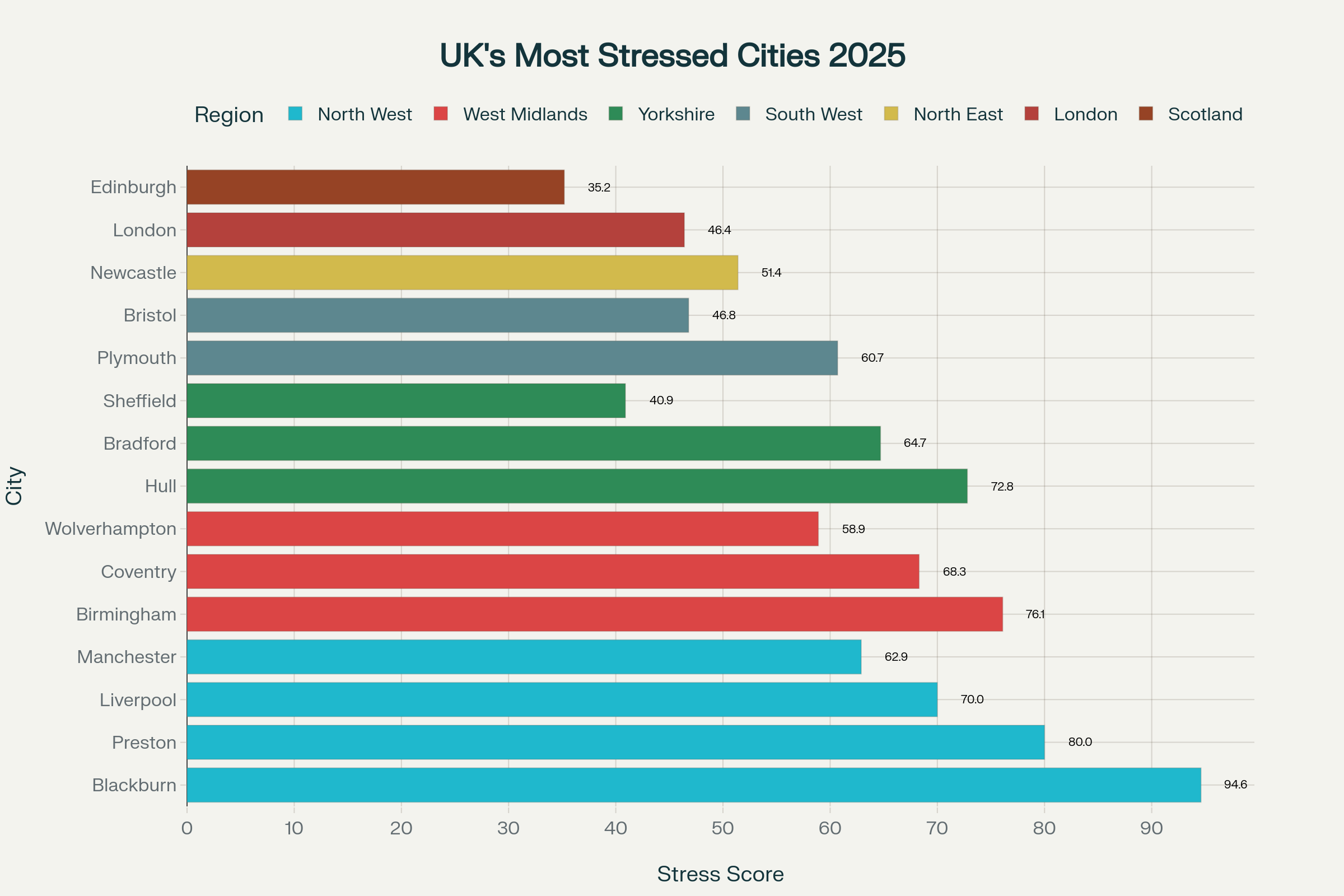
Most stressed cities by region
The North West is the UK’s most stressed region, with Blackburn emerging as the UK’s most stressed city with a composite stress score of 94.6, driven by the highest mental health prevalence rate in the UK (16.2%) and consistently elevated stress indicators across all measured categories. The Lancashire town has maintained its position in the top 20% most deprived areas since 2000, with unemployment at 4.7% above the national average.
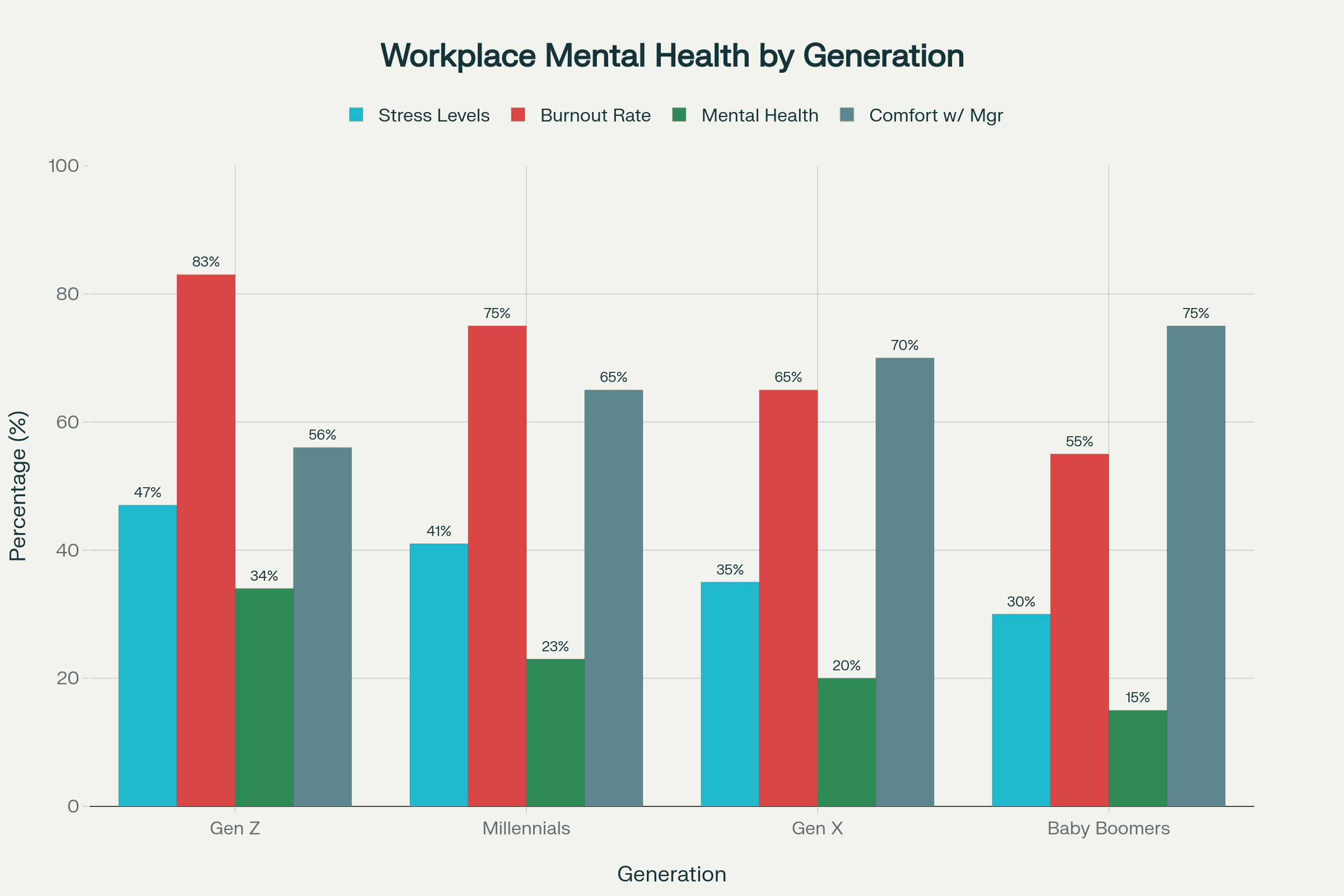
Workplace mental health by generation
We found a stark generational divide defines workplace mental health across the UK, with Gen Z workers (18-24) experiencing 47% stress levels compared to just 30% among Baby Boomers. Most alarmingly, 83% of Gen Z frontline workers report burnout symptoms, significantly higher than the 75% overall frontline average. Young workers are also three times more likely to take time off work due to mental health issues (34% vs 15% for those aged 55+).
How To Improve Stress, Wellness & Mental Health
Quick wins that help today
- A 10 minute brisk walk or stair session resets mood and energy through light, movement and breath.
- Two minutes of slow breathing 4 in 6 out signals safety to the nervous system.
- Caffeine cut off after midday if sleep is disrupted.
- Reduce evening screen time and keep phones out of the bedroom.
- Write a short plan for tomorrow before bed to lower rumination.
Build a strong sleep routine
- Same sleep and wake time every day, including weekends.
- Morning daylight exposure for 10 to 20 minutes.
- Cool, dark, quiet bedroom and a 30 to 60 minute wind down.
- Keep alcohol and heavy meals away from bedtime.
- Consider nutrition that supports sleep quality, for example, tart cherry, which naturally contains melatonin and polyphenols. If using a supplement, take it 30 to 60 minutes before bed.
Move, eat, and hydrate
- Aim for 2+ hours of moderate activity weekly plus two strength sessions.
- Plate balance at meals. Half vegetables and fruit, a quarter protein, a quarter wholegrains.
- Stay hydrated. Even mild dehydration can raise stress levels.
- Keep alcohol within low-risk guidance and plan alcohol free days.
Train the mind like a muscle
- Five senses grounding. Name 5 things you can see, 4 you can feel, 3 you can hear, 2 you can smell, 1 you can taste.
- Thought reframing. Write the worry, write a balanced alternative, choose a small action.
- Worry window. Set 15 minutes at a fixed time to list worries, then return to your day.
- Journalling three lines each evening. One win, one challenge, one plan for tomorrow.
Protect your work life balance
- Define start and finish times and honour a real lunch break.
- Work in 25 to 50 minute focus blocks with short active breaks.
- Turn off non essential notifications and batch email checks.
- Speak to your manager early if workload or role clarity is a concern. Ask about Employee Assistance Programmes or NHS Talking Therapies.

Exercise
Regular movement lowers stress by easing muscle tension and lifting mood. Even 10 minutes of brisk walking can calm the nervous system and improve sleep.

Diet
Balanced meals steady blood sugar, which helps prevent the jittery, irritable feelings linked to stress. Focus on fibre, protein and healthy fats, stay hydrated, and keep caffeine and alcohol in check.

Sleep
Poor sleep and stress fuel each other. Protect a consistent routine to lower cortisol, stabilise mood and build resilience. Aim for a cool, dark room and a wind-down period each night.
Great resources for mental health
- https://www.nhs.uk/mental-health/self-help/guides-tools-and-activities/five-steps-to-mental-wellbeing/
- https://www.nhs.uk/mental-health/feelings-symptoms-behaviours/feelings-and-symptoms/stress/
- https://www.nhs.uk/every-mind-matters/
- https://www.mind.org.uk/information-support/types-of-mental-health-problems/stress/managing-stress-and-building-resilience/
- https://www.mentalhealth.org.uk/explore-mental-health/a-z-topics/stress
- https://www.youngminds.org.uk/young-person/
- https://www.rethink.org/aboutus/what-we-do/advice-and-information-service
Where our data came from
Data sources
See our compiled data in a spreadsheet here.
- https://www.priorygroup.com/mental-health/mental-health-statistics
- https://www.frontiersin.org/journals/drug-safety-and-regulation/articles/10.3389/fdsfr.2023.1303572/full
- https://www.firstresponsetraining.com/hse-publishes-latest-workplace-health-and-safety-statistics/
- https://www.thehrdirector.com/business-news/mental-health/birmingham-tops-list-burnout-symptom-searches-uk/
- https://hrreview.co.uk/hr-news/wellbeing-news/new-study-identifies-the-uks-most-burnt-out-regions/376065
- https://mentalhealth-uk.org/blog/burnout-report-2025-reveals-generational-divide-in-levels-of-stress-and-work-absence/
- https://www.deloitte.com/uk/en/about/press-room/deloitte-genz-and-millennial-survey-uk-genzs-and-millennials-reject-employers-who-dont-align-with-their-values.html
- https://www.kcl.ac.uk/news/youth-mental-health-in-decline-generations-differ-on-causes-of-apparent-crisis-survey-finds
- https://www.peoplemanagement.co.uk/article/1894415/80-per-cent-gen-z-frontline-workers-facing-burnout-study-finds
- https://www.ciphr.com/infographics/workplace-stress-statistics
- https://www.psychreg.org/london-tops-global-list-cities-searching-burnout-signs/
- https://www.instantoffices.com/blog/instant-offices-news/stressed-cities-to-work-in-uk/
- https://www.yorkshirepost.co.uk/arts-and-culture/stress-awareness-month-sheffield-named-the-uks-sixth-most-stressed-city-5064329
- https://www.frontiersin.org/articles/10.3389/fdata.2024.1365417/full
- https://wellcomeopenresearch.org/articles/5-220/v1/pdf
- https://www.nhsbsa.nhs.uk/statistical-collections/medicines-used-mental-health-england/medicines-used-mental-health-england-quarterly-summary-statistics-20242025/medicines-used-mental-health-england-quarterly-summary-statistics-april-june-2024
- https://www.england.nhs.uk/long-read/national-medicines-optimisation-opportunities-2023-24/
- https://www.nhsbsa.nhs.uk/prescription-data/dispensing-data/dispensing-contractors-data
- https://www.ons.gov.uk/peoplepopulationandcommunity/wellbeing/bulletins/measuringnationalwellbeing/april2022tomarch2023
- https://whatworkswellbeing.org/resources/local-authority-wellbeing-over-time/
- https://www.ons.gov.uk/peoplepopulationandcommunity/wellbeing/methodologies/personalwellbeingintheukqmi
- https://www.weightmans.com/media-centre/news/mental-health-dominates-hse-workplace-statistics-20232024/
- https://press.hse.gov.uk/2024/11/20/hse-publishes-annual-work-related-ill-health-and-injury-statistics-for-2023-24/
- https://www.britsafe.org/safety-management/2024/burnout-britain-how-can-we-reduce-stress-and-put-out-the-fire
- https://euc7zxtct58.exactdn.com/wp-content/uploads/2024/01/19145241/Mental-Health-UK_The-Burnout-Report-2024.pdf
- https://assets.publishing.service.gov.uk/media/65b2347f1702b10013cb1281/Narrative_for_well-being_mission.pdf
- https://institute.global/insights/public-services/data-decoded-charting-the-trends-and-costs-of-declining-mental-health-in-the-uk
- https://www.gov.uk/government/statistics/chapters-for-english-housing-survey-2023-to-2024-headline-findings-on-demographics-and-household-resilience/chapter-4-well-being-and-loneliness
- https://www.ons.gov.uk/peoplepopulationandcommunity/healthandsocialcare/healthcaresystem/bulletins/experiencesofnhshealthcareservicesinengland/september2024
- https://www.ons.gov.uk/datasets/wellbeing-local-authority
- https://www.gov.uk/government/consultations/health-and-social-care-statistical-outputs/health-and-social-care-statistical-outputs-published-by-dhsc-including-ohid-nhsbsa-ukhsa-ons-and-nhs-england
- https://scimatic.org/show_manuscript/6219
- https://www.researchprotocols.org/2024/1/e55470
- https://ajms.iq/index.php/ALRAFIDAIN/article/view/2099
- https://scimatic.org/show_manuscript/6321
- https://www.ijmsdh.org/index.php/ijmsdh/article/view/491/382
- https://journal.unnes.ac.id/journals/kemas/article/view/20561
- https://pantaojournal.com/2025/06/17/v4-i2-172/
- https://journal.universitaspahlawan.ac.id/index.php/ners/article/view/42618
- https://academic.oup.com/eurpub/article/doi/10.1093/eurpub/ckae144.1354/7844462
- https://dera.ioe.ac.uk/id/eprint/34934/1/SN06988 (redacted).pdf
- https://www.timeout.com/uk/news/the-northern-city-named-britains-most-stressful-place-to-live-061025
- https://www.centreformentalhealth.org.uk/wp-content/uploads/2024/11/CentreforMH_MappingTheMentalHealthOfUKYoungPeople.pdf
- https://screenshot-media.com/gen-z-news/gen-z-ditching-big-cities/
- https://www.mccarthyandstone.co.uk/articles-and-news/property-advice/generational-living-hotspots/
- https://www.hippocraticpost.com/mental-health/new-study-names-the-uks-most-burnt-out-regions/
- https://www.brookes.ac.uk/about-brookes/news/news-from-2024/12/study-reveals-mental-health-diversity-and-work-lif
- https://www.mentalhealth.org.uk/explore-mental-health/statistics
- https://www.bbc.com/worklife/article/20220520-why-gen-z-workers-are-already-so-burned-out
- https://www.theuktimes.co.uk/top-10-uk-cities-for-a-balanced-work-life-lifestyle-in-2025/
- https://www.england.nhs.uk/wp-content/uploads/2025/01/fft-mental-health-data-nov-24.xlsm
- https://www.newcastleworld.com/community/newcastle-ranked-one-of-the-most-anxious-cities-in-the-uk-for-sunday-night-work-stress-5205679
- https://www.ons.gov.uk/peoplepopulationandcommunity/healthandsocialcare/mentalhealth
- https://papers.academic-conferences.org/index.php/ecel/article/view/3035
- http://www.emerald.com/ict/article/56/3/258-269/1236397
- https://academic.oup.com/humrep/article/doi/10.1093/humrep/deae108.803/7703801
- https://academic.oup.com/ijpp/article/32/Supplement_2/ii39/7885418
- https://wsj.westsciences.com/index.php/wsbm/article/view/100
- https://journaljesbs.com/index.php/JESBS/article/view/1372
- https://e-journal.citakonsultindo.or.id/index.php/IJBQR/article/view/1771
- http://www.magonlinelibrary.com/doi/10.12968/nuwa.2019.Sup6.29
- https://www.semanticscholar.org/paper/bc725157db1c869341d30bf98c4d8b2c2d4382f4
- https://www.tandfonline.com/doi/pdf/10.1080/23311975.2024.2327120?needAccess=true
- https://onlinelibrary.wiley.com/doi/pdfdirect/10.1111/sjop.12955
- https://www.frontiersin.org/articles/10.3389/fpsyg.2023.1042397/pdf?isPublishedV2=False
- https://www.frontiersin.org/articles/10.3389/fpsyg.2021.736820/pdf
- https://www.ijcmph.com/index.php/ijcmph/article/view/14478
- https://invergejournals.com/index.php/ijss/article/view/167
- https://invergejournals.com/index.php/ijss/article/view/161
- https://www.semanticscholar.org/paper/cf4d187b7169b60883b81c709533b9b66dcf57a8
- https://ijpds.org/article/download/2264/4694
- https://www.cambridge.org/core/services/aop-cambridge-core/content/view/2DDDF51DCC766B078048355A950B9E9E/S1758320900003632a.pdf/div-class-title-public-mental-health-the-local-tangibles-div.pdf
- https://www.cambridge.org/core/services/aop-cambridge-core/content/view/DB1594A33619D25A50F2FA1EF2316D5B/S0955603600094940a.pdf/div-class-title-distribution-of-case-load-in-community-mental-health-teams-div.pdf
- https://www.cambridge.org/core/services/aop-cambridge-core/content/view/C1814A3228BCDBA5A9F697C231622628/S0033291720005048a.pdf/div-class-title-the-mental-health-impact-of-covid-19-and-lockdown-related-stressors-among-adults-in-the-uk-div.pdf
- https://www.cambridge.org/core/services/aop-cambridge-core/content/view/S0007125000229681
- https://www.cambridge.org/core/services/aop-cambridge-core/content/view/2E0546C1870622E2383C4A154A176D12/S2056469418000797a.pdf/div-class-title-the-forgotten-foundations-in-core-mental-health-services-no-one-can-hear-you-scream-div.pdf
- https://pmc.ncbi.nlm.nih.gov/articles/PMC8159668/
- https://pmc.ncbi.nlm.nih.gov/articles/PMC10442733/
- https://jech.bmj.com/content/jech/early/2023/12/12/jech-2023-221223.full.pdf
- https://www.cambridge.org/core/services/aop-cambridge-core/content/view/D7E2EA268395EC63205017929CD720D2/S2056472421000429a.pdf/div-class-title-impact-of-the-covid-19-pandemic-on-the-mental-health-and-well-being-of-uk-healthcare-workers-div.pdf
- https://pmc.ncbi.nlm.nih.gov/articles/PMC11066558/
- https://mentalhealth.bmj.com/lookup/doi/10.1136/bmjment-2024-301018
- https://pmc.ncbi.nlm.nih.gov/articles/PMC7843955/
- https://pmc.ncbi.nlm.nih.gov/articles/PMC8142438/
- https://pmc.ncbi.nlm.nih.gov/articles/PMC3520993/
- https://www.cambridge.org/core/services/aop-cambridge-core/content/view/7958E73170D75E749864D89B4CFCC1C2/S2056472420001040a.pdf/div-class-title-patterns-of-use-of-secondary-mental-health-services-before-and-during-covid-19-lockdown-observational-study-div.pdf
- https://www.mind.org.uk/media/vbbdclpi/the-big-mental-health-report-2024-mind.pdf
- https://mentalhealth.bmj.com/content/26/1/e300855
- https://www.lancashire.gov.uk/media/903069/life-satisfaction-personal-wellbeing-article.pdf
- https://www.ons.gov.uk/visualisations/dvc1262/wellbeingmap/index.html
- https://www.bma.org.uk/advice-and-support/nhs-delivery-and-workforce/pressures/mental-health-pressures-data-analysis
- https://pmc.ncbi.nlm.nih.gov/articles/PMC11652419/
- https://www.ons.gov.uk/visualisations/nesscontent/dvc238/index.html
- https://www.mind.org.uk/about-us/our-policy-work/the-big-mental-health-report-2024/
- https://www.england.nhs.uk/mental-health/taskforce/imp/mh-dashboard/
- https://media.nhsbsa.nhs.uk/press-releases/5171d616-95ea-4282-959b-15f8bfed6a0f/nhs-releases-2023-24-mental-health-medicines-statistics-for-england
- https://www.assemblyresearchmatters.org/2025/04/03/happiness-in-the-spotlight-happiness-across-the-uk-and-northern-ireland/
- https://www.ons.gov.uk/peoplepopulationandcommunity/healthandsocialcare/mentalhealth/datalist
- https://www.ons.gov.uk/aboutus/transparencyandgovernance/freedomofinformationfoi/datarelatingtodepressionandanxietysincethebeginningofthepandemic
- https://www.ons.gov.uk/visualisations/dvc2773/fig6/index.html
- https://www.gov.uk/government/publications/prescribed-medicines-review-report/prescribed-medicines-review-summary
- https://worldwellbeingmovement.org/wp-content/uploads/2024/03/The-UK-Wellbeing-Report-2024-World-Wellbeing-Movement.pdf
- https://academic.oup.com/occmed/article-lookup/doi/10.1093/occmed/kqp146
- https://www.semanticscholar.org/paper/01ef55d4ea397aa41a676721d29530902d5b0200
- https://pmc.ncbi.nlm.nih.gov/articles/PMC11044501/
- https://www.frontiersin.org/articles/10.3389/fpsyg.2022.823080/pdf
- https://www.tandfonline.com/doi/pdf/10.1080/09585192.2024.2429128?needAccess=true
- https://academic.oup.com/bjsw/advance-article-pdf/doi/10.1093/bjsw/bcac214/47073600/bcac214.pdf
- https://www.mdpi.com/2673-3986/3/1/3/pdf?version=1644200122
- https://www.mdpi.com/1660-4601/17/18/6464/pdf
- https://academic.oup.com/occmed/article/72/1/25/6387721
- https://onlinelibrary.wiley.com/doi/10.1002/ajim.23583
- https://pmc.ncbi.nlm.nih.gov/articles/PMC11544989/
- https://pmc.ncbi.nlm.nih.gov/articles/PMC10949874/
- https://jech.bmj.com/content/jech/early/2022/03/15/jech-2021-218561.full.pdf
- https://www.mdpi.com/1660-4601/19/8/4646/pdf
- https://mhfaengland.org/mhfa-centre/blog/Key-workplace-mental-health-statistics-for-2024/
- https://www.hpft.nhs.uk/media/azlh5shc/hpft-guidelines-on-choice-and-selection-of-antidepressants-for-the-management-of-depression-v20-final-feb-2025.pdf
- https://www.ecsafetysolutions.com/news/hse-annual-statistics-highlight-worrying-trend-around-mental-health
- https://mentalhealth-uk.org/burnout/
- https://trends.google.com/trends/explore?geo=GB&hl=en-GB
- https://nhssomerset.nhs.uk/prescribing-and-medicines-management/prescribing-guidelines-by-clinical-area/mental-health-prescribing/
- https://www.hse.gov.uk/statistics/overview.htm
- https://www.forthwithlife.co.uk/blog/mental-health-statistics-uk/
- https://cpe.org.uk/our-news/prescription-charge-to-rise-to-9-90-on-1-may-2024/
- https://www.hse.gov.uk/statistics/
- https://www.gov.scot/publications/quality-prescribing-antidepressants-guide-improvement-2024-2027/pages/19/
- https://discovery.ucl.ac.uk/10133048/1/1-s2.0-S0165032721006741-main.pdf
- https://formative.jmir.org/2023/1/e44055/PDF
- https://www.mdpi.com/1660-4601/21/2/202/pdf?version=1707467348
- https://onlinelibrary.wiley.com/doi/10.1002/pcn5.70101
- https://www.mdpi.com/1660-4601/18/23/12369/pdf
- https://pmc.ncbi.nlm.nih.gov/articles/PMC12034257/
- https://pmc.ncbi.nlm.nih.gov/articles/PMC4224516/
- https://wellcomeopenresearch.org/articles/5-82/v2
- https://pmc.ncbi.nlm.nih.gov/articles/PMC10131769/
- https://pmc.ncbi.nlm.nih.gov/articles/PMC11747232/
- https://www.england.nhs.uk/long-read/summary-of-electronic-prescribing-and-medicine-administration-epma-directions-2024-issued-to-nhs-england-by-the-secretary-of-state-for-health-and-social-care-in-may-2024/
- https://openprescribing.net
- https://www.nhsbsa.nhs.uk/statistical-collections/prescription-cost-analysis-england/prescription-cost-analysis-england-202425