


If you’ve had a UTI, you’ll know the feeling. That unmistakable burning. The constant urge to go to the toilet. The exhaustion of another course of antibiotics, followed by the quiet dread of wondering when it’s going to happen again.
For many people, UTIs aren’t a one-off. Approximately 50% to 60% of adult women will experience at least one urinary tract infection during their lifetime, with 20% to 24% experiencing recurrence within a year. That’s a huge number of people stuck in a cycle that’s uncomfortable, disruptive, and often difficult to talk about.
The good news is that there’s a growing body of research looking at what actually helps, and it goes beyond just drinking more cranberry juice.
This guide breaks down what we know about UTI prevention supplements, the lifestyle habits worth building into your routine, and when it’s time to stop self-managing and speak to your GP.
First, what actually causes a UTI?
Most UTIs are caused by bacteria, most commonly E. coli, entering the urethra and travelling up into the bladder. Once there, the bacteria attach to the lining of the bladder wall and begin to multiply.
This is why the goal of most preventative approaches, whether supplement-based or lifestyle-based, is to make it harder for bacteria to take hold in the first place. Rather than killing bacteria after the fact (which is what antibiotics do), prevention focuses on reducing the conditions that allow bacteria to adhere and thrive.
Women are significantly more prone to UTIs than men, largely due to anatomy. A shorter urethra means bacteria have a shorter distance to travel. Hormonal changes around the menopause can also alter the vaginal microbiome, which plays a role in keeping harmful bacteria in check.
The most researched supplement for UTI prevention: D-mannose
If you’ve started looking into UTI supplements, you’ve probably come across D-mannose.
D-mannose is a naturally occurring simple sugar found in small amounts in some fruits. It’s not absorbed in the same way as glucose, which means it passes relatively intact into the urine. The theory behind its use for UTI prevention is interesting: E. coli bacteria have tiny hair-like structures (called fimbriae) that they use to latch onto the bladder wall. D-mannose is thought to bind to these structures instead, essentially giving the bacteria something else to grip onto, so they’re more likely to be flushed out when you urinate rather than settling into the bladder lining [1].
What does the research say about D-mannose?
This is where we want to be straight with you, because the research picture is currently mixed and you deserve an honest answer rather than a marketing one.
Some earlier trials showed real promise. A 2013 study comparing D-mannose with a commonly prescribed antibiotic found D-mannose to be comparably effective at preventing recurrent UTIs over six months, with fewer side effects [2].
However, a large UK randomised controlled trial published in JAMA Internal Medicine in 2024, which followed 598 women with recurrent UTIs across 99 NHS primary care settings, found that the proportion experiencing a medically attended UTI was 51.0% in those taking daily D-mannose over 6 months and 55.7% in those taking placebo, a difference that did not reach statistical significance [3].
A more recent meta-analysis from 2025 concluded similarly: that the results across available randomised trials do not confirm the efficacy of D-mannose for the prophylaxis of recurrent UTIs in adult women. However, the possibility of a beneficial effect cannot be ruled out. [4]
It’s worth noting that some of the earlier, more positive trials recruited patients from specialist urology clinics, while the 2024 UK trial recruited from the general population in primary care. The people experiencing UTIs in community settings are a much more varied group, with potentially different causes and bacterial profiles, which may explain some of the difference in results.
So why do we still offer it?
Because “the evidence is mixed” is not the same as “it doesn’t work.”
For many women, D-mannose does appear to make a real difference, and that likely comes down to individual variation. UTIs aren’t all identical. The specific bacteria involved, how well your bladder lining naturally resists adhesion, your hormonal environment, your microbiome, these factors all vary from person to person.
A supplement that works through a very specific mechanism, like D-mannose targeting E. coli adhesion, will naturally perform better for some people than others. That’s not a flaw in the science, it’s just biology.
We also think it’s worth putting D-mannose in context. Cranberry juice is the go-to for a huge number of people dealing with UTIs, yet its evidence base is, if anything, similarly inconclusive, and most shop-bought versions come loaded with added sugar that your urinary health definitely doesn’t need. If you’re already reaching for something as part of your routine, D-mannose is a more targeted, better-tolerated option with a clearer proposed mechanism.
We keep a close eye on emerging research in this space, and we’re genuinely hopeful that larger, more inclusive clinical trials will give us a clearer picture of exactly who benefits most from D-mannose and under what conditions. The science isn’t finished here, and we think it’s heading in a positive direction.
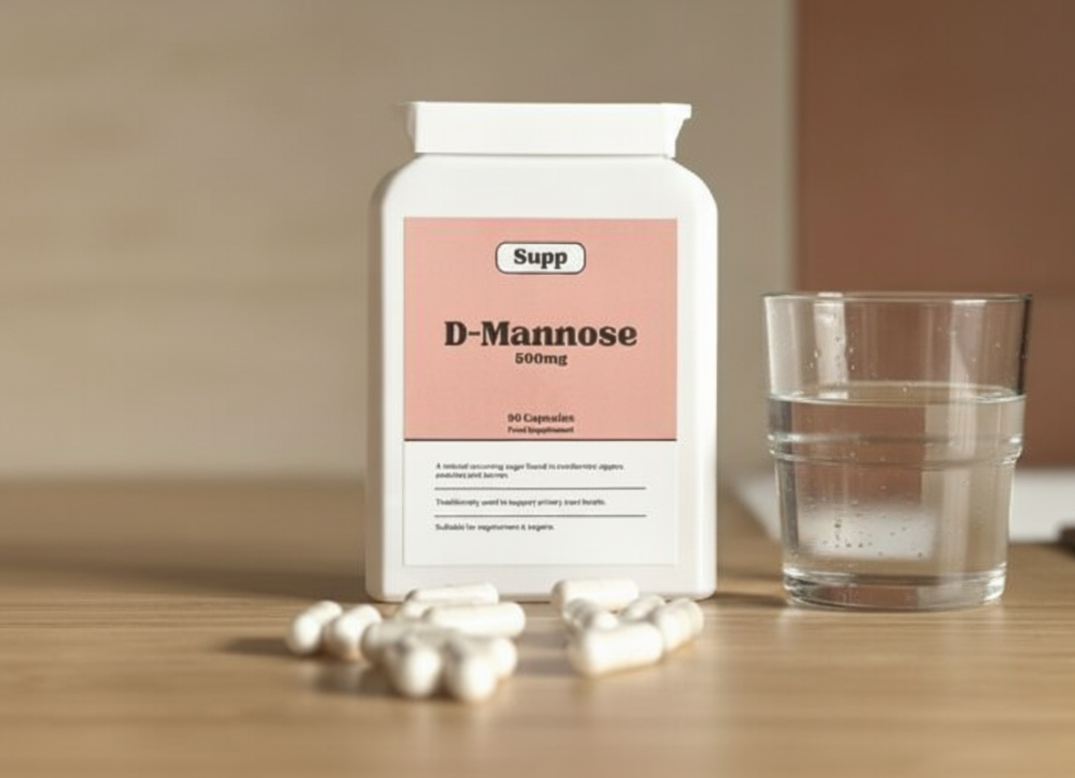
D-mannose is well-tolerated, has a good safety profile, and continues to be the subject of active research. It’s not a silver bullet, but for many people, it remains a key part of a broader urinary health routine. If you’re considering trying it, our D-mannose supplement is manufactured in the UK to GMP standards, with no unnecessary fillers.
Other supplements with a role in urinary health
Cranberry
Cranberries contain compounds called proanthocyanidins (PACs), which work through a similar mechanism to D-mannose, potentially making it harder for bacteria to stick to the urinary tract lining. The evidence here is also mixed. A Cochrane review found that cranberry products may reduce recurrence in some women, particularly at higher PAC concentrations, but concluded that more research is needed [5].
If you do use cranberry supplements, the form matters. Shop-bought cranberry juice is often heavily diluted and high in sugar, which doesn’t do much for your urinary health. A concentrated supplement with standardised PAC content is a more useful option.
Probiotics
Your gut microbiome and your urinary health are more connected than you might think. Around 70% of the body’s immune cells reside in the gut, making gut health a key player in immune defence and therefore beneficial for urinary health. Specific strains, particularly Lactobacillus species, may help support a healthy vaginal microbiome, which acts as a natural protective barrier against harmful bacteria reaching the urinary tract [6]. Research is ongoing, but supporting your gut with a diverse, fibre-rich diet is a solid foundation regardless.
Daily habits that support urinary health
Supplements work best as part of a lifestyle, not a replacement for one. Here are the habits with real evidence behind them.
Stay well hydrated
This is the most consistently supported recommendation. Drinking enough water throughout the day helps to regularly flush the urinary tract, reducing the time bacteria have to settle. Aim for around 1.5 to 2 litres per day as a general guide, more if you’re active or it’s warm [7].
Don’t delay going to the toilet
Holding urine for long periods gives any bacteria present more time to multiply. When you feel the urge, go. It sounds simple, but it’s something many people overlook during busy working days.
Wipe front to back
Basic hygiene, but worth stating clearly. Wiping from front to back after going to the toilet reduces the risk of bacteria from the bowel reaching the urethra.
Urinate after sex
Sexual activity is one of the more common triggers for UTIs in women, as it can introduce bacteria to the urethra. Urinating shortly after sex helps to flush any bacteria before they have the chance to travel further.
Consider what you wear
Breathable, cotton underwear allows less moisture to build up compared to synthetic fabrics, which creates a less hospitable environment for bacterial growth.
Be mindful of certain hygiene products
Strongly scented products, douches, and some lubricants can disrupt the delicate bacterial balance of the vagina and urethra. If you’re prone to UTIs, it’s worth reviewing the products you use in that area.
When to see a doctor
This matters, and we want to be clear about it.
Supplements and lifestyle changes are valuable for supporting urinary health and potentially reducing recurrence risk. They are not a treatment for an active infection.
If you’re experiencing any of the following, speak to your GP:
- A burning sensation when urinating
- Frequent, urgent need to urinate with little output
- Cloudy, dark, or strong-smelling urine
- Pain in your lower abdomen or back
- Blood in your urine
- A temperature, chills, or feeling generally unwell (these can indicate the infection has reached the kidneys, which requires prompt treatment)
If you’re getting recurrent UTIs (two or more in six months, or three or more in a year), your GP can help identify any underlying causes and discuss preventative strategies alongside you, including whether antibiotic prophylaxis is appropriate for your situation.
The most common approach to prophylaxis of recurrent UTI is daily antibiotic use, which while effective during the period of prophylaxis, increases risk of subsequent resistant UTIs and adverse effects. This is exactly why many people are exploring supplementary approaches as part of their conversation with their doctor.
Never delay seeking medical care for a suspected UTI, particularly if symptoms are severe or you feel unwell beyond the typical urinary symptoms.
Key Takeaways:
Preventing recurrent UTIs takes a joined-up approach. D-mannose is one of the most studied options available, and while the evidence is currently mixed, it remains a reasonable choice for many people when used alongside good hydration, sensible hygiene habits, and regular communication with your GP.
At Supp, we believe you deserve the full picture, not just the parts that sound good in a product description. Our D-mannose supplement is made in the UK, free from unnecessary additives, and designed for daily use as part of a practical, evidence-led approach to urinary health.
And if you want to understand more about how individual ingredients work, our ingredient library is a good place to start.
As always, consult your health practitioner before starting any new supplement, particularly if you’re pregnant, breastfeeding, or managing an existing health condition.