



Vitamin D supplements can be confusing. You can get bottles ranging from 10 micrograms to 100 micrograms and beyond. Not to mention some measure in mcg and some in IU. So how much do you actually need?
The honest answer is that it depends. Your skin tone, where you live, how much time you spend indoors, your age, and your diet all influence how much vitamin D your body has available. But there are clear baseline figures from the NHS and EFSA worth knowing. We’ll break it down for you in this guide.
A Quick Guide To Vitamin D:
The NHS Daily Recommendation for How Much Vitamin D for UK Adults
The Department of Health and Social Care recommends that adults and children over the age of one get 10 micrograms of vitamin D every day [1]. That’s the equivalent of 400 international units, or IU, the other unit you’ll commonly see on supplement labels.
This guidance applies year-round, but the NHS specifically recommends supplementation during autumn and winter for everyone in the UK [1].
Why? Because between October and March, the sun sits at an angle where UVB rays aren’t strong enough to trigger vitamin D production in skin, no matter how long you spend outside.
For some people, the NHS recommends year-round supplementation:
- Adults whose skin has little or no exposure to the sun
- People with darker skin tones, as more melanin reduces vitamin D synthesis
- Pregnant and breastfeeding women
IU vs Micrograms: The Conversion
Vitamin D is measured in two units, and supplement labels use them interchangeably.
The conversion is straightforward: 1 microgram (mcg or μg) equals 40 IU.
So:
- 10 mcg = 400 IU (NHS daily recommendation)
- 25 mcg = 1,000 IU (a common low over-the-counter dose)
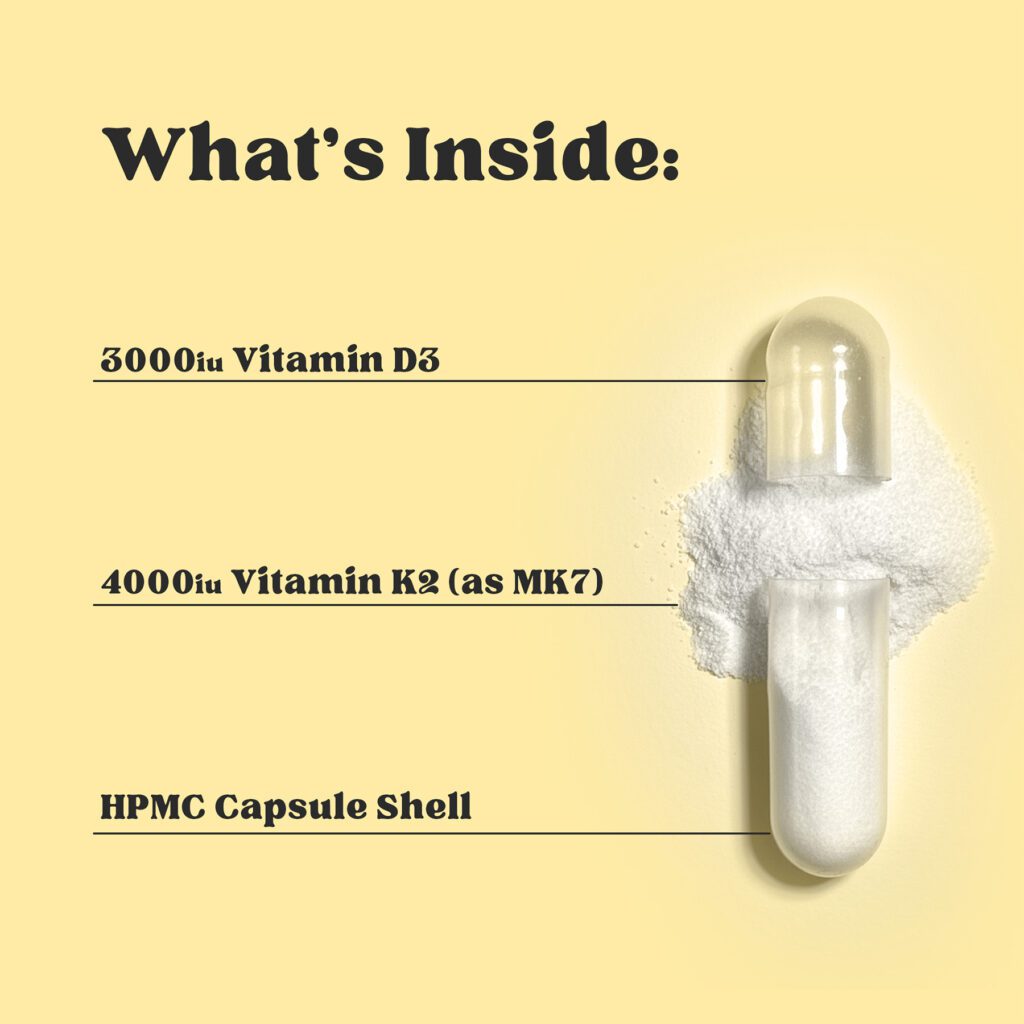
- 75 mcg = 3,000 IU (Supp doseage)
- 100 mcg = 4,000 IU (EFSA upper safe limit)
When comparing supplements, always check both numbers. A bottle labelled “1,000 IU” sounds high until you realise it’s a perfectly normal 25 mcg dose.
Who Might Need More Than the Minimum
The 10 mcg figure is the population baseline. It’s the amount that should keep most people from becoming deficient. But it isn’t necessarily the optimal amount for everyone.
Several groups may benefit from a higher daily dose:
- People with darker skin: melanin reduces UVB absorption, so skin produces less vitamin D for the same sun exposure
- Adults over 65: skin makes vitamin D less efficiently with age, and dietary intake is often lower
- Indoor workers: limited sun exposure means less natural production, even in summer
- People who cover their skin: for cultural reasons, religious reasons, or sun protection
- Vegans and vegetarians: most natural food sources of vitamin D (oily fish, egg yolks) are animal-based
- People who carry more body fat: vitamin D is fat-soluble and can be sequestered in body tissue, making less available
- Anyone with limited mobility: less time outdoors means less natural production
If you fall into one or more of these groups, the NHS minimum is the floor, not the ceiling. Many supplements offer higher daily doses (typically 1,000 to 4,000 IU) to provide a more meaningful margin.
If you’re not sure whether you’re low, you can ask your GP for a 25-hydroxyvitamin D blood test, which gives you a number for your current status. You might also recognise some of the signs of low vitamin D in autumn and winter if you’re trying to spot whether you’re affected.
The Upper Safe Limit
Some people may think more is always better. For Vitamin D, this isn’t the case.
The European Food Safety Authority sets the tolerable upper intake level for adults at 100 micrograms (4,000 IU) per day [2]. This is the amount considered unlikely to cause adverse effects when taken long-term.
Above this level, the risks include too much calcium in the blood, which can cause nausea, kidney issues and, in severe cases, problems with heart rhythm. Vitamin D toxicity is rare, but it’s almost always caused by very high-dose supplements taken for extended periods, not by diet or sun exposure.
Sensible dosing means staying within evidence-based ranges. For most healthy adults, anywhere between 400 IU and 3,000 IU daily covers the spectrum of recommendations comfortably.
When and How to Take Vitamin D
Because vitamin D is fat-soluble, your body absorbs it more efficiently when there’s some fat in your digestive tract at the same time. Research has shown that taking it with a meal containing fat can significantly increase absorption compared with taking it on an empty stomach [3].
For a Vitamin D supplement:
- Take it with breakfast, lunch, or dinner rather than between meals
- A small amount of fat is enough, think avocado, olive oil, eggs, or dairy
- Consistency matters more than time of day. Vitamin D works best when taken regularly, not when squeezed in at a specific hour
There’s no strong clinical reason to take it morning or evening, although many people prefer the morning so they don’t forget.
What to Look For in a Vitamin D Supplement
Not all vitamin D supplements are built the same. Here’s what to check on the label.
The form
D3 (cholecalciferol) is generally more effective at raising blood levels than D2 (ergocalciferol). If you want a deeper dive on this, we’ve covered the difference between D3 and D2 in detail.
The dose
Anywhere from 400 IU to 4,000 IU is reasonable for adults. Higher doses suit specific situations, lower doses suit most people. Match the dose to your actual needs, not the loudest marketing claim.
K2 inclusion
Vitamin D helps your body absorb calcium, but K2 helps direct that calcium into your bones and away from soft tissues. The two work together. We cover why D3 and K2 belong together in more detail.
Manufacturing standards
Look for GMP-certified production, ideally made in the UK or EU. This is your safeguard for what’s actually in the capsule.
Minimal fillers
A clean ingredient list is a good sign. Skip anything with unnecessary additives, artificial colours, or unnamed “proprietary blends” where you can’t see exact amounts of each ingredient.
Our Vitamin D3 + K2 is GMP-made in the UK and combines both nutrients in a single daily capsule, with no unnecessary extras.
FAQ’s
Can I get enough vitamin D from food alone?
For most people in the UK, no. Even with regular consumption of oily fish, egg yolks, mushrooms exposed to UV light, and fortified foods, it’s difficult to hit 10 mcg consistently from food, especially in winter.
Can I get enough vitamin D from sunlight in summer?
For a short window of the year, yes, particularly between May and September if you spend regular time outside with skin exposed (without sunscreen for short periods). But during autumn and winter, the sun isn’t strong enough at UK latitudes regardless of weather.
Is it better to take vitamin D daily or weekly?
Daily dosing is the most consistent way to maintain blood levels. Weekly or monthly mega-dosing exists in some clinical settings, but for general health, daily is simplest and reflects how the body naturally maintains vitamin D.
Can I take vitamin D with other supplements?
Yes. Vitamin D pairs particularly well with K2 (for the calcium direction question above) and magnesium, which supports vitamin D metabolism. Many high-quality formulations combine D3 with K2 in one capsule for convenience.
Does the time of year I start matter?
Not really. The body builds up vitamin D stores gradually, so starting in October is sensible, but starting in January or even March is still worthwhile. Supplementation works on cumulative exposure, not one-off doses.
To Conclude
The NHS recommendation of 10 micrograms daily is a sensible starting point for UK adults, particularly between October and March. Some people benefit from more, but the upper safe limit from supplements sits at 100 micrograms (4000IU) per day.
The form matters (D3 over D2), the timing matters (with food), and the pairing matters (K2 for bone health). Choose a clean, transparent supplement made to GMP standards, and the fundamentals are covered.
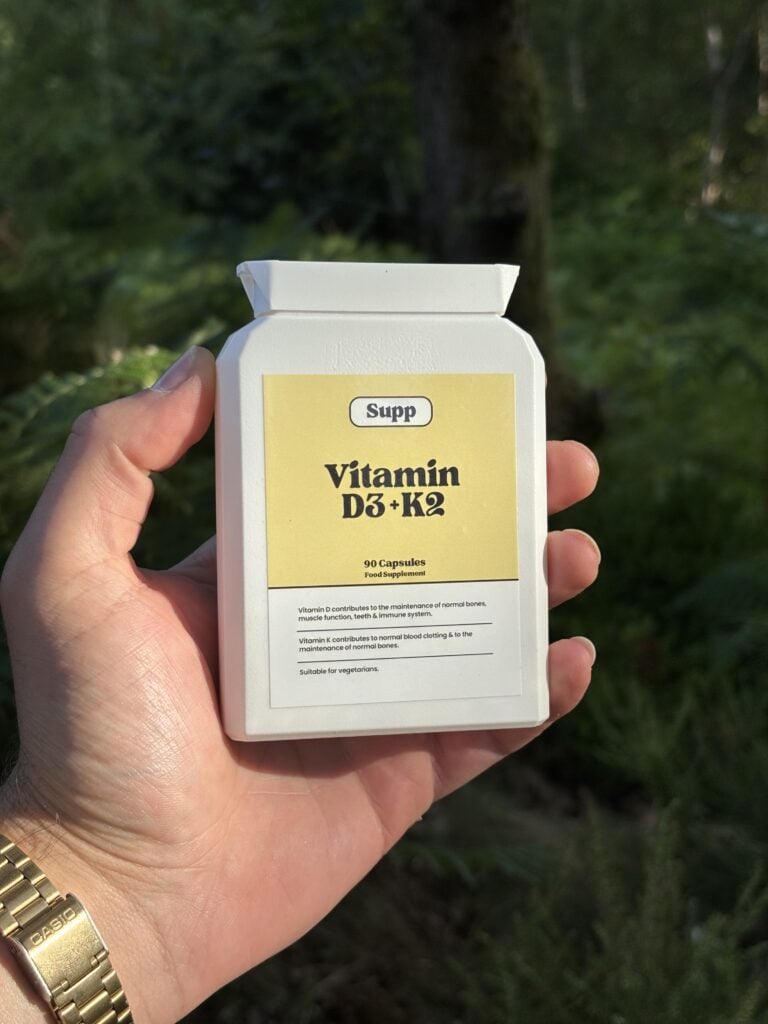
If you’d like one that ticks all those boxes, our Vitamin D3 + K2 is built for daily use, GMP-made in the UK.
References
- NHS. 2020. Vitamin D. https://www.nhs.uk/conditions/vitamins-and-minerals/vitamin-d/
- EFSA Panel on Dietetic Products, Nutrition and Allergies. 2012. Scientific Opinion on the Tolerable Upper Intake Level of vitamin D. EFSA Journal, 10(7):2813. https://www.efsa.europa.eu/en/efsajournal/pub/2813
- Mulligan GB, Licata A. 2010. Taking vitamin D with the largest meal improves absorption and results in higher serum levels of 25-hydroxyvitamin D. Journal of Bone and Mineral Research, 25(4):928-930. https://pubmed.ncbi.nlm.nih.gov/20200983/
Disclaimer:
This article is for general information and isn’t a substitute for medical advice. If you’re pregnant, breastfeeding, taking medication, or managing a health condition, speak to your GP or a qualified healthcare practitioner before starting a new supplement.