



Finding the best vitamin D supplement UK shoppers can actually trust should be simple. In practice, it isn’t. Search for one and you’ll spot the problem straight away: dozens of bottles, all promising high strength, all showing a big number on the front, and very little to tell them apart at a glance.
Here’s the thing. Vitamin D supplements vary more than most people realise, and the differences that matter rarely show up in that headline number. The form of vitamin D, whether it’s paired with the right partner nutrient, and how open the brand is about what’s actually inside all count for more than a large figure on the label.
This guide walks through what genuinely separates a good vitamin D supplement from one that’s likely to do less than you’d hope, so you can choose with confidence.
Why the number on the front isn’t the whole story
Most vitamin D supplements lead with strength. You’ll see 1000iu, 3000iu or 4000iu printed large, as though a bigger number automatically means a better product.
Strength does matter, and we’ll come to sensible dosing shortly. But on its own, that figure tells you nothing about the form of vitamin D you’re getting, whether your body can put the calcium it helps you absorb to good use, or what else is sitting in the capsule alongside it.
Two supplements showing the same iu can behave quite differently once they’re inside you. The rest of this guide is about the details that decide which is which.
What to look for in a vitamin D supplement
1. Vitamin D3, not D2
Vitamin D comes in two main forms. Vitamin D2 (ergocalciferol) is usually derived from yeast or fungi. Vitamin D3 (cholecalciferol) is the same form your skin makes when it’s exposed to sunlight.
This isn’t a minor technicality. A systematic review and meta-analysis of randomised controlled trials found that vitamin D3 is more effective than D2 at raising and maintaining the level of vitamin D in your blood [4]. If you’re taking a supplement to keep your levels topped up, D3 is the more dependable choice for most people.
D2 still has its place, particularly for anyone following a strict vegan diet, though vegan D3 made from lichen is now widely available too. We’ve covered the full comparison in our guide to vitamin D3 vs D2. The short version: look for D3 on the label.
2. A partner for the calcium: vitamin K2
This is the factor most vitamin D supplements skip, and it’s arguably the most interesting one.
Vitamin D’s main job is helping your body absorb calcium. But absorbing calcium is only half the story. Your body then needs to put that calcium in the right place, which is your bones, rather than letting it settle in soft tissue.
That’s where vitamin K2 comes in. K2 activates the proteins that help direct calcium into your bones, finishing the job that vitamin D starts. The two nutrients complement each other, which is why you’ll increasingly see them sold together, and why researchers have studied the pair for bone outcomes rather than D3 on its own [6]. Vitamin K2 also contributes to the maintenance of normal bones and to normal blood clotting.
If a vitamin D supplement doesn’t include K2, you’re getting half of a partnership. We’ve explained exactly how the two work alongside each other in our article on why vitamin D3 and K2 work better together.
3. A sensible, effective dose
Now to that number on the front.
In the UK, the Scientific Advisory Committee on Nutrition recommends that everyone aged 4 and over considers a daily 10µg (400iu) of vitamin D, particularly through autumn and winter when sunlight is in short supply [2]. That’s the baseline for avoiding a shortfall.
Many people choose a higher strength than the bare minimum, especially if they get little sun or have tested low. A daily dose somewhere in the region of 25µg to 75µg (1000iu to 3000iu) is a common, well-tolerated choice. The key is not to overdo it. NHS guidance advises that most adults shouldn’t take more than 100µg (4000iu) a day unless a doctor has told them to [3].
So the sweet spot for most people is a D3 supplement comfortably above the 10µg floor and safely below the 100µg ceiling. Strength purely for the sake of a bigger label number isn’t the goal.
4. The right form of K2 (MK-7)
If a supplement does include K2, it’s worth checking which form. The two you’ll see are MK-4 and MK-7.
MK-7 is the one to look for. Research shows it stays active in the body for longer and is absorbed more effectively, which means a small daily amount can do its job consistently [5]. A good D3 and K2 supplement will state MK-7 clearly on the label rather than simply listing “vitamin K2” and leaving you guessing.
5. Transparent labelling
A supplement you can trust tells you exactly what’s inside, in plain language, with every active ingredient and its amount listed.
Be wary of vague wording or missing detail. You want to see the specific form of vitamin D (D3), the exact dose in both µg and iu, the form and amount of K2, and a full list of anything else in the capsule, including the capsule shell and any flow agents. A brand that’s confident in its formula has no reason to hide any of it. We don’t believe in hidden blends, and nor should the supplement you choose.
6. UK made and GMP certified
Manufacturing standards vary between countries. GMP (Good Manufacturing Practice) certification means a facility has been independently audited against defined quality and safety standards, and in the UK that production also sits under Food Standards Agency oversight.
In practice, this gives you confidence that what’s printed on the label is actually in the capsule, at the stated dose, and free from contamination. It’s the difference between a supplement you can trust and one you shouldn’t.
What to avoid
A few things worth watching for when you compare vitamin D supplements:
- D2 when you could have D3. Unless you specifically need a plant-derived option, D3 is the more effective form for keeping your levels up.
- D3 on its own when bone support is the goal. Without K2, the calcium your body absorbs has nothing helping to direct it to where it’s most useful.
- Vitamin K2 with no form stated. If the label doesn’t say MK-7, you can’t be sure what you’re getting.
- Mega-doses with no context. A huge iu figure isn’t a badge of quality, and going above 100µg a day isn’t something to do casually.
- No manufacturing information. If a brand won’t tell you where or how its supplements are made, that’s a meaningful gap.
- Wild promises. Vitamin D is well researched and genuinely useful, but any brand claiming it will cure or fix a specific condition is overstating the science and likely breaking UK advertising rules in the process.
What does vitamin D actually support?
It helps to be clear about what vitamin D is for, in language that reflects what the evidence actually supports.
Vitamin D contributes to the normal absorption and use of calcium, to the maintenance of normal bones, teeth and muscle function, and to the normal function of the immune system. That last point is part of why interest in vitamin D tends to climb through the colder months. Around 1 in 6 adults in the UK have low vitamin D levels, with the shortfall most common in autumn and winter when there’s less sunlight to make it from [1].
Vitamin K2, the partner nutrient, contributes to the maintenance of normal bones and to normal blood clotting.
It’s worth being honest about what a supplement is and isn’t. It isn’t a treatment for any medical condition. It’s a daily top-up that, alongside a balanced diet and a sensible lifestyle, helps your body do what it’s built to do. If you want to work out whether you might be running low, our piece on the signs of low vitamin D in autumn and winter is a good place to start.

What we use at Supp
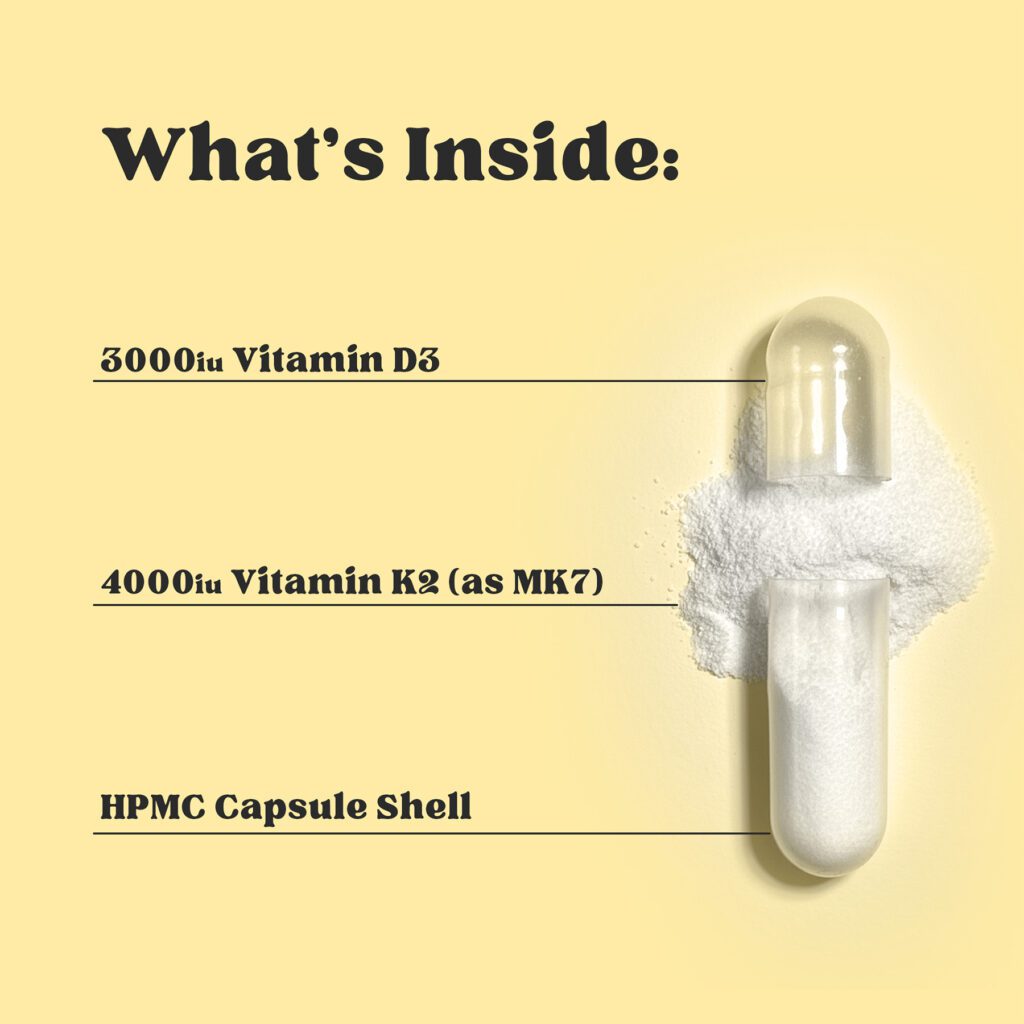
Our Vitamin D3 & K2 is built around the criteria above. Each capsule delivers 3000iu (75µg) of vitamin D3 alongside 100µg of vitamin K2 as MK-7, so you get the more effective form of vitamin D and the partner nutrient that helps direct calcium to your bones, all in one daily capsule.
That dose sits comfortably above the 10µg baseline and well within the 100µg daily upper limit, which makes it a practical year-round choice for most adults, and a sensible one through the darker months in particular. No hidden blends, no unnecessary fillers, and clear labelling that lists every ingredient and its amount.
It’s made in the UK in GMP-certified, BRCGS AA-rated facilities, and the capsule shell is suitable for vegetarians. One note on suitability: because the D3 is sourced from cholecalciferol, this product isn’t suitable for vegans, and the K2 is sourced from soya, so it isn’t suitable for anyone with a soya allergy. One capsule a day, taken with food.
You can find the full ingredient breakdown at supp.store/immunity/vitamin-d3-k2/.

Frequently asked questions
What is the best vitamin D supplement to take?
For most people, a vitamin D3 supplement is the more effective choice, since D3 raises and maintains blood levels better than D2. Pairing it with vitamin K2 as MK-7 adds the partner nutrient that helps direct absorbed calcium towards your bones. Beyond that, look for transparent labelling, a sensible dose, and UK GMP-certified manufacturing.
How much vitamin D should I take a day?
UK guidance recommends a minimum of 10µg (400iu) a day, especially in autumn and winter [2]. Many people opt for a higher strength, commonly between 25µg and 75µg (1000iu to 3000iu). Most adults shouldn’t exceed 100µg (4000iu) a day unless advised by a doctor [3].
Is D3 better than D2?
For raising your vitamin D levels, the evidence points to D3. A meta-analysis of randomised controlled trials found D3 more effective than D2 at increasing and maintaining blood levels of vitamin D [4]. D2 is mainly relevant for people who specifically want a plant-derived form, though vegan D3 is now widely available too.
Why is vitamin K2 added to vitamin D?
Vitamin D helps your body absorb calcium, and vitamin K2 helps make sure that calcium is directed into your bones. Taken together, they offer more complete support for bone health than D3 on its own, which is why the two are so often combined.
Can I take vitamin D every day?
Yes, daily use is how most people take it, and consistency tends to matter more than a high dose. Stay within the recommended limits, and if you’re pregnant, breastfeeding, taking medication (particularly blood thinners, as vitamin K can interact with them), or under medical care, check with your GP first.
When is the best time to take vitamin D?
Vitamin D is fat soluble, so taking it with a meal that contains some fat helps absorption. Many people find that taking it with breakfast makes it easier to remember and stay consistent.
Scientific resources & clinical studies
Vitamin D3 is more effective than D2 at raising blood levels
A systematic review and meta-analysis of randomised controlled trials compared the two forms of vitamin D directly. It concluded that D3 is more efficacious than D2 at raising serum 25-hydroxyvitamin D, the marker used to assess vitamin D status, making D3 the more reliable choice for supplementation. Read the study here
Disclaimer
Food supplements should not be used as a substitute for a varied, balanced diet and a healthy lifestyle. If you are pregnant, breastfeeding, taking medication, or have a medical condition, consult your doctor before use. Always consult your healthcare practitioner before taking nutritional supplements.
References
- Office for Health Improvement and Disparities. National Diet and Nutrition Survey 2019 to 2023. GOV.UK. https://www.gov.uk/government/statistics/national-diet-and-nutrition-survey-2019-to-2023/national-diet-and-nutrition-survey-2019-to-2023-report
- Scientific Advisory Committee on Nutrition. 2016. Vitamin D and Health. GOV.UK. https://www.gov.uk/government/publications/sacn-vitamin-d-and-health-report
- NHS. Vitamin D. https://www.nhs.uk/conditions/vitamins-and-minerals/vitamin-d/
- Tripkovic L, Lambert H, Hart K, et al. 2012. Comparison of vitamin D2 and vitamin D3 supplementation in raising serum 25-hydroxyvitamin D status: a systematic review and meta-analysis. The American Journal of Clinical Nutrition. https://pubmed.ncbi.nlm.nih.gov/22552031/
- Schurgers LJ, Teunissen KJF, Hamulyák K, et al. 2007. Vitamin K-containing dietary supplements: comparison of synthetic vitamin K1 and natto-derived menaquinone-7. Blood. https://pubmed.ncbi.nlm.nih.gov/17158229/
- Ushiroyama T, Ikeda A, Ueki M. 2002. Effect of continuous combined therapy with vitamin K2 and vitamin D3 on bone mineral density and coagulofibrinolysis function in postmenopausal women. Maturitas. https://pubmed.ncbi.nlm.nih.gov/11886767/