

If your knees grumble on the stairs, your hands feel stiff first thing, or your joints just don’t move the way they used to, you’ve probably already reached for glucosamine. It’s the name most people know, the one sitting on every pharmacy shelf.
But there’s another option that far fewer people have heard of, and the science behind it is arguably more interesting. Green lipped mussel has quietly built up a body of research for joint comfort, yet it rarely gets a look in.
So how do they actually compare? Let’s walk through Green Lipped Mussel vs Glucosamine: what each one is, how they work, and what the research really says, so you can decide what’s right for your body.
The quick answer
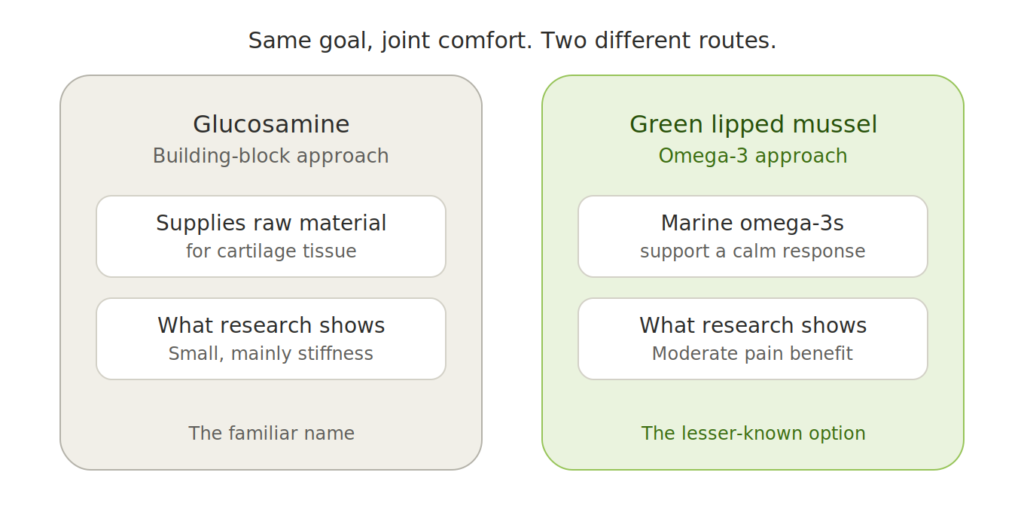
Glucosamine and green lipped mussel both get talked about for joint support, but they work in completely different ways. Glucosamine is a compound your body already uses to help build cartilage, so supplementing is a top up the raw materials idea. Green lipped mussel is a whole-food marine extract rich in omega-3 fatty acids, and its interest for joints is linked to the body’s natural inflammatory processes.
The honest answer is this: the evidence for glucosamine is surprisingly patchy, while green lipped mussel has shown more consistent signals in reviews of joint research. Both work best as part of a wider routine.
What is glucosamine, and how does it work?
Glucosamine is a natural sugar compound found in the fluid around your joints and in cartilage, the smooth, cushioning tissue that stops your bones grinding against each other. As we age, cartilage naturally wears, which is why joints can start to feel stiff or achy.
The theory behind glucosamine supplements is simple and appealing. If cartilage is made partly from glucosamine, then giving your body more of it might help support the tissue. Most supplements use glucosamine sulphate or glucosamine hydrochloride, often paired with chondroitin.
It’s a sensible-sounding idea. The trouble is that the research hasn’t backed it up as strongly as the popularity suggests.
According to research indexed on PubMed, a large meta-analysis of glucosamine and chondroitin trials found that glucosamine showed a significant effect only on joint stiffness, rather than clearly reducing pain or improving overall function versus a placebo [1]. A separate systematic review that looked across many different joint supplements reached a similar conclusion, describing glucosamine as either ineffective or offering effects too small to be clinically meaningful [2].
That doesn’t mean nobody feels a benefit. Plenty of people take glucosamine and report they get on well with it, and it’s generally considered well tolerated. It simply means the weight of evidence is weaker than most people assume.
What is green lipped mussel, and how does it work?
Green lipped mussel (its scientific name is Perna canaliculus) is a shellfish native to the coastal waters of New Zealand. Local communities have eaten it for generations, and researchers became curious after noticing links between the diet and joint health. If you’d like the full backstory, we’ve written about where green lipped mussels come from in a separate piece.

Here’s the key difference from glucosamine. Green lipped mussel isn’t a single building-block compound. It’s a nutrient-dense marine extract that contains a distinctive mix of omega-3 fatty acids, alongside proteins, minerals and antioxidants.
Those marine omega-3s are the interesting part. Omega-3 fatty acids are involved in the body’s normal inflammatory response, which matters because a lot of everyday joint discomfort is tied to inflammation in and around the joint. Green lipped mussel carries some rarer fatty acids not commonly found in other foods, which is a big reason it’s studied separately from standard fish oil. We compare the two in more detail in our guide to green lipped mussel vs fish oil.
On the research side, the signals have been more encouraging. Based on articles retrieved from PubMed, a systematic review of green lipped mussel extract in people with osteoarthritis pooled several trials and reported a clinically meaningful positive effect on pain scores, while noting the extract was generally well tolerated [3]. A pilot study of a high-dose extract reported improvements in joint pain, stiffness and mobility, and also noted better digestive comfort in participants [4].
Lab work has explored why. One study found the omega-3-rich extract helped calm markers of inflammation in cartilage cells and protected against cartilage breakdown in an experimental model, pointing to how those marine fatty acids might act at a cellular level [5]. A wider review of the mussel’s bioactive components describes anti-inflammatory and antioxidant activity spread across its fatty acids, proteins and peptides, rather than resting on one single ingredient [6].
To be clear and fair, this is still a developing area, and researchers consistently call for larger, higher-quality trials. But the direction of travel is more positive than many people expect from an ingredient they’ve never heard of.
Head to head: what the research suggests
The most useful comparison comes from a systematic review that assessed twenty different supplements side by side for joint use. It’s worth quoting the shape of its findings, because it puts our two contenders in the same room.
In that review, widely used options such as glucosamine and chondroitin were rated as either ineffective or offering small effects of unclear clinical importance. Green lipped mussel, by contrast, was one of only a couple of supplements the authors highlighted as showing a clinically important effect on pain over the medium term [2].
So on a like-for-like basis, using the same review and the same measuring stick, green lipped mussel came out looking like the stronger performer for joint comfort. That’s a genuinely surprising result given how much better known glucosamine is.
A quick, honest caveat: joint research is notoriously messy. Studies vary in dose, format, quality and length, and individual responses differ hugely. No single review settles the debate. But if you’re weighing up where to put your money, it’s fair to say the evidence base for green lipped mussel is at least as strong, and arguably more consistent, than the one for glucosamine.
So which one should you take?
It helps to stop thinking of them as direct rivals doing the identical job, because they don’t.
Glucosamine might appeal to you if you like the “supply the raw materials” idea, you’ve used it before and felt fine on it, or you specifically want to try the most established name first. Just go in with realistic expectations about the strength of the evidence.
Green lipped mussel might suit you if you’re drawn to an omega-3-led approach, you want a whole-food marine source rather than an isolated compound, or you’ve tried glucosamine without much luck and fancy something with a different mechanism. It’s also worth noting it’s a natural source of the marine omega-3s many of us don’t get enough of anyway.
If your interest is joint comfort tied to an active lifestyle, you might also look at ingredients like turmeric with black pepper or Montmorency cherry extract.
How Supp does Green Lipped Mussel
If green lipped mussel is new to you, transparency matters even more, because you want to know exactly what you’re taking and why.
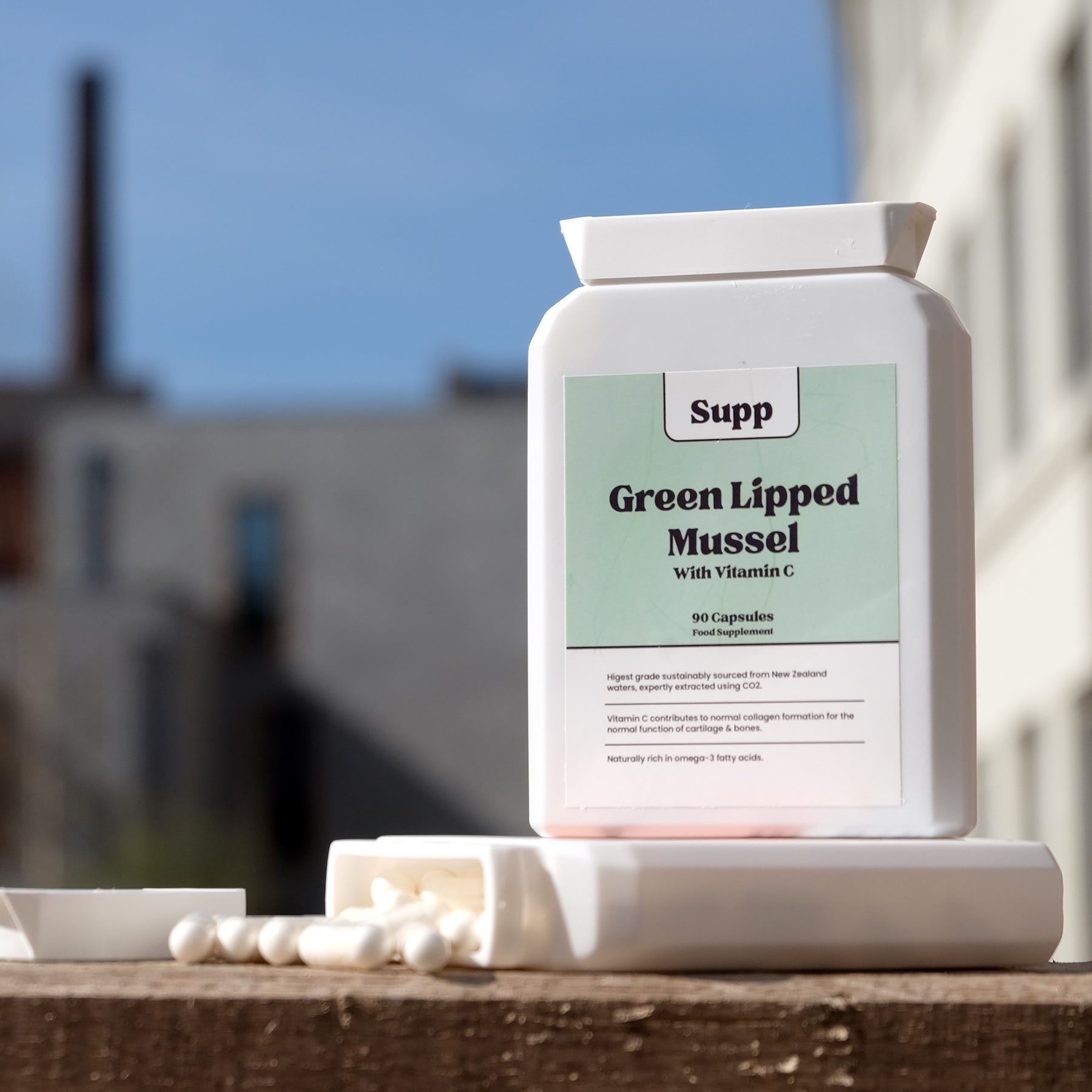
Our Green Lipped Mussel is made in the UK in a GMP-certified facility, using extract sourced from New Zealand waters. No vague proprietary blends are hiding the real amounts, and no unnecessary fillers padding out the capsule. You can read exactly what goes into it on our Green Lipped Mussel product page, which is part of our wider commitment to clear, honest labelling.
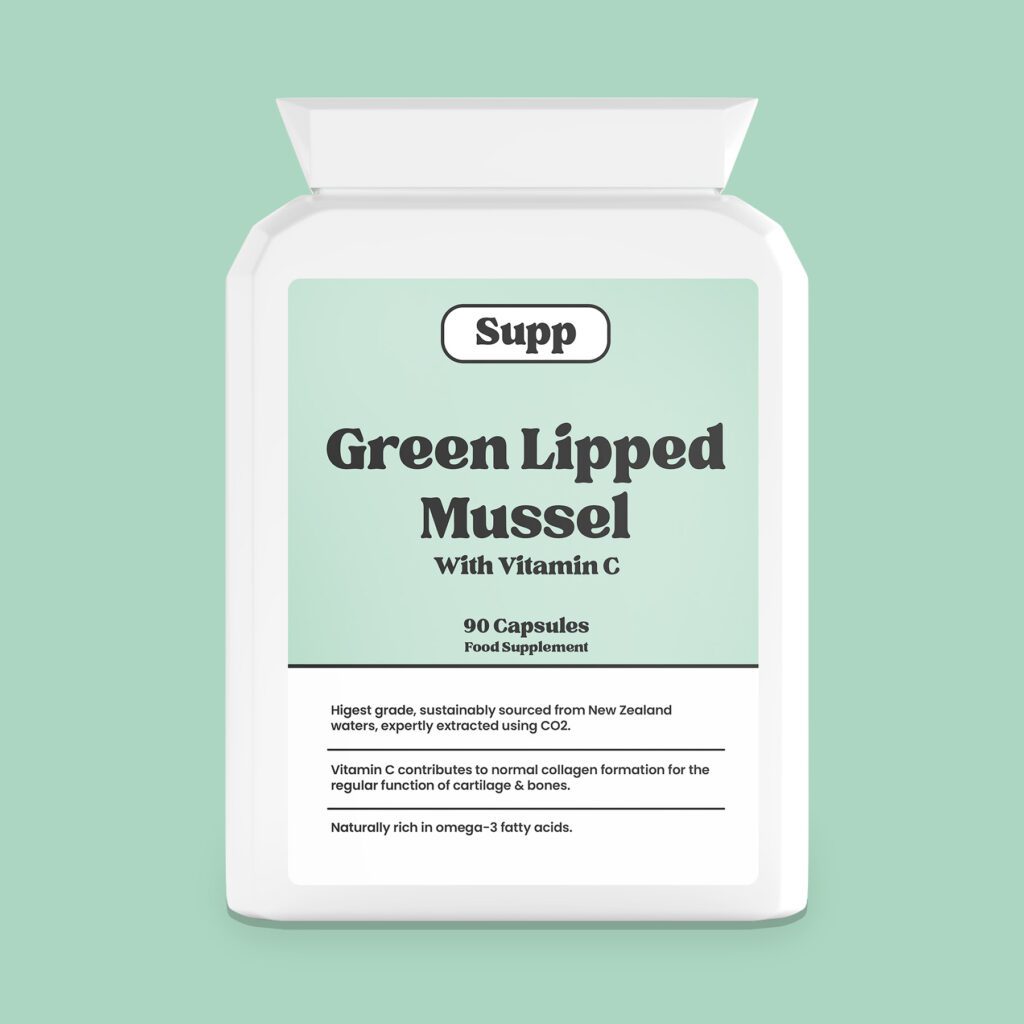
Because it’s shellfish-derived, green lipped mussel isn’t suitable if you have a shellfish allergy, and it isn’t vegan. That’s exactly the kind of thing we think you should know up front rather than discover on the back label.
Supplements are one piece of the puzzle
Whichever route you take, the most reliable thing you can do for your joints is keep them moving. Gentle, regular strength and mobility work helps the muscles around a joint do their job, which takes pressure off the joint itself.
Our hip mobility and strength routine is a good place to start if stiffness is your main gripe, and it pairs nicely with a diet built around whole foods, oily fish and plenty of colourful veg. A supplement is there to support a good routine, not to rescue a missing one.
To Conclude
Glucosamine is the household name, but familiarity and evidence aren’t the same thing. When you line the two up using the same research, green lipped mussel holds its own and, in at least one major review, edged ahead for joint comfort.
If you’ve been loyal to glucosamine out of habit, green lipped mussel is well worth understanding. And if you’re starting from scratch, it’s a genuinely credible, science-led place to begin.
Our Green Lipped Mussel is UK made in a GMP-certified facility, using extract sourced from New Zealand waters, with no hidden blends or unnecessary fillers. If you’ve been curious about an omega-3-led approach to joint comfort, it’s a great place to start.
Disclaimer:
Always consult your health practitioner before use, particularly if you’re pregnant, breastfeeding, taking medication, or managing a health condition. Green lipped mussel is derived from shellfish and is not suitable for anyone with a shellfish allergy. This article is for general information only and isn’t intended to diagnose, treat, or cure any medical condition.
References
The studies below are indexed on PubMed. Links go to the PubMed record for each paper.
- Zhu X, Sang L, Wu D, Rong J, Jiang L. 2018. Effectiveness and safety of glucosamine and chondroitin for the treatment of osteoarthritis: a meta-analysis of randomized controlled trials. Journal of Orthopaedic Surgery and Research. https://pubmed.ncbi.nlm.nih.gov/29980200/
- Liu X, Machado GC, Eyles JP, Ravi V, Hunter DJ. 2018. Dietary supplements for treating osteoarthritis: a systematic review and meta-analysis. British Journal of Sports Medicine. https://pubmed.ncbi.nlm.nih.gov/29018060/
- Abshirini M, Coad J, Wolber FM, von Hurst P, Miller MR, Tian HS, Kruger MC. 2021. Green-lipped (greenshell) mussel (Perna canaliculus) extract supplementation in treatment of osteoarthritis: a systematic review. Inflammopharmacology. https://pubmed.ncbi.nlm.nih.gov/33738701/
- Coulson S, Vecchio P, Gramotnev H, Vitetta L. 2012. Green-lipped mussel (Perna canaliculus) extract efficacy in knee osteoarthritis and improvement in gastrointestinal dysfunction: a pilot study. Inflammopharmacology. https://pubmed.ncbi.nlm.nih.gov/22366869/
- Jhun J, Na HS, Cho KH, et al. 2021. A green-lipped mussel reduces pain behavior and chondrocyte inflammation and attenuated experimental osteoarthritis progression. PLoS One. https://pubmed.ncbi.nlm.nih.gov/34855756/
- Coulson S, Palacios T, Vitetta L. 2015. Perna canaliculus (Green-Lipped Mussel): bioactive components and therapeutic evaluation for chronic health conditions. Progress in Drug Research. https://pubmed.ncbi.nlm.nih.gov/26462365/