

If you’ve ever searched for a marine collagen supplement, you’ll know the feeling. Dozens of options, all promising glowing skin and stronger nails, all looking more or less the same from the outside.
The honest answer is that marine collagen supplements do vary considerably. The differences aren’t always obvious at first glance, but they matter when it comes to whether you actually get the results you’re hoping for.
This guide is about helping you make a genuinely informed choice. Not which brand to buy blindly, but what to actually look for, and why those things make a difference.
Why marine collagen specifically?
Collagen is the most abundant protein in the human body. It’s a structural protein, which means it forms the framework of your skin, bones, tendons, ligaments and connective tissue. It’s what gives skin its firmness and elasticity, and what keeps joints cushioned and resilient.
The problem is that your body naturally produces less of it as you get older. Production starts to slow from your mid-twenties, and by the time you’re in your forties and fifties, the effects on your skin and joints can become harder to ignore.
Marine collagen is sourced from fish, most commonly from the skin and scales. What makes it stand out from other sources, such as bovine collagen from cattle, is two things: the type of collagen it contains and how easily your body can use it.
Marine collagen is predominantly Type I collagen, the same type that makes up around 80-90% of the collagen in human skin [1]. It also has a lower molecular weight than land-animal collagen, which means it’s absorbed more efficiently once it reaches your digestive system. Research suggests it can be up to 1.5 times more bioavailable than bovine collagen [2].
For anyone focused primarily on skin, hair and nails, marine collagen is generally considered the most targeted option. We’ve compared the two in more detail in our guide to marine vs bovine collagen if you want to go deeper on that.
What to actually look for in a marine collagen supplement
1. Hydrolysed collagen peptides, not just “marine collagen”
This is the single most important thing on the label.
Standard collagen molecules are large. Too large, in fact, for your body to absorb intact. For a marine collagen supplement to be effective, the collagen needs to have been broken down into smaller fragments called peptides. This process is called hydrolysis, and the result is what’s known as hydrolysed collagen or collagen peptides.
When you take hydrolysed marine collagen, these smaller peptides are absorbed through the gut wall and enter the bloodstream. From there, they reach the skin and other tissues, where they appear to signal fibroblast cells to produce more of your own collagen and supporting proteins like elastin and hyaluronic acid [3].
This is important because collagen supplements don’t work by depositing collagen directly into your skin. The mechanism is more indirect, which is why the quality of the hydrolysis process and the peptide size matter.
If a label just says marine collagen without specifying that it’s hydrolysed, it’s worth digging a little further before you commit.
2. A dose that reflects the evidence
Once you’re confident you’re looking at hydrolysed collagen, the next thing to check is dose. This is where a lot of supplements fall down, often quietly, and not always in the direction you’d expect.
Clinical research into oral collagen spans a wide dosage range. Some studies have used very high daily amounts, 5g, 10g or more, particularly in powder or liquid format. But there’s also solid evidence for meaningful results at lower doses. A well-designed trial published in 2024 found significant improvements in skin hydration, elasticity and hair condition after 12 weeks using a daily hydrolysed collagen supplement [5]. Research consistently shows that what matters most is the quality of the hydrolysis, how well the peptides are absorbed, and whether you’re taking it every day, not just loading up on the highest number on the label.
For capsule supplements, dose is a practical consideration. Each capsule has a finite capacity, and a good two-capsule daily serving can realistically deliver around 1,000-1,200mg of hydrolysed marine collagen. That’s a meaningful, consistently deliverable daily dose, particularly when it’s paired with vitamin C to support collagen synthesis.
The important thing is to check the actual serving suggestion rather than the per-capsule figure, and to choose a supplement you’ll genuinely take every day. Consistency matters more than chasing the highest number.
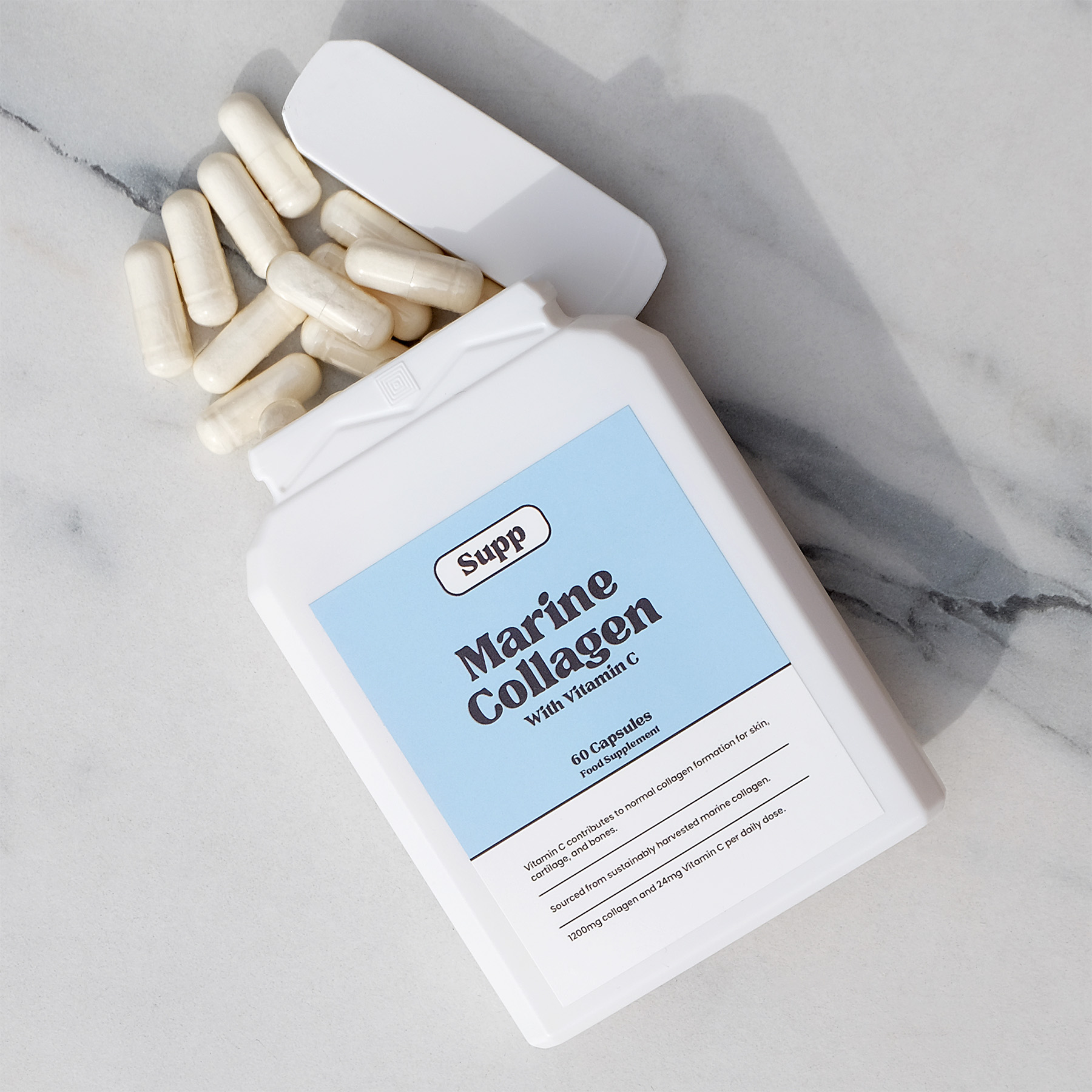
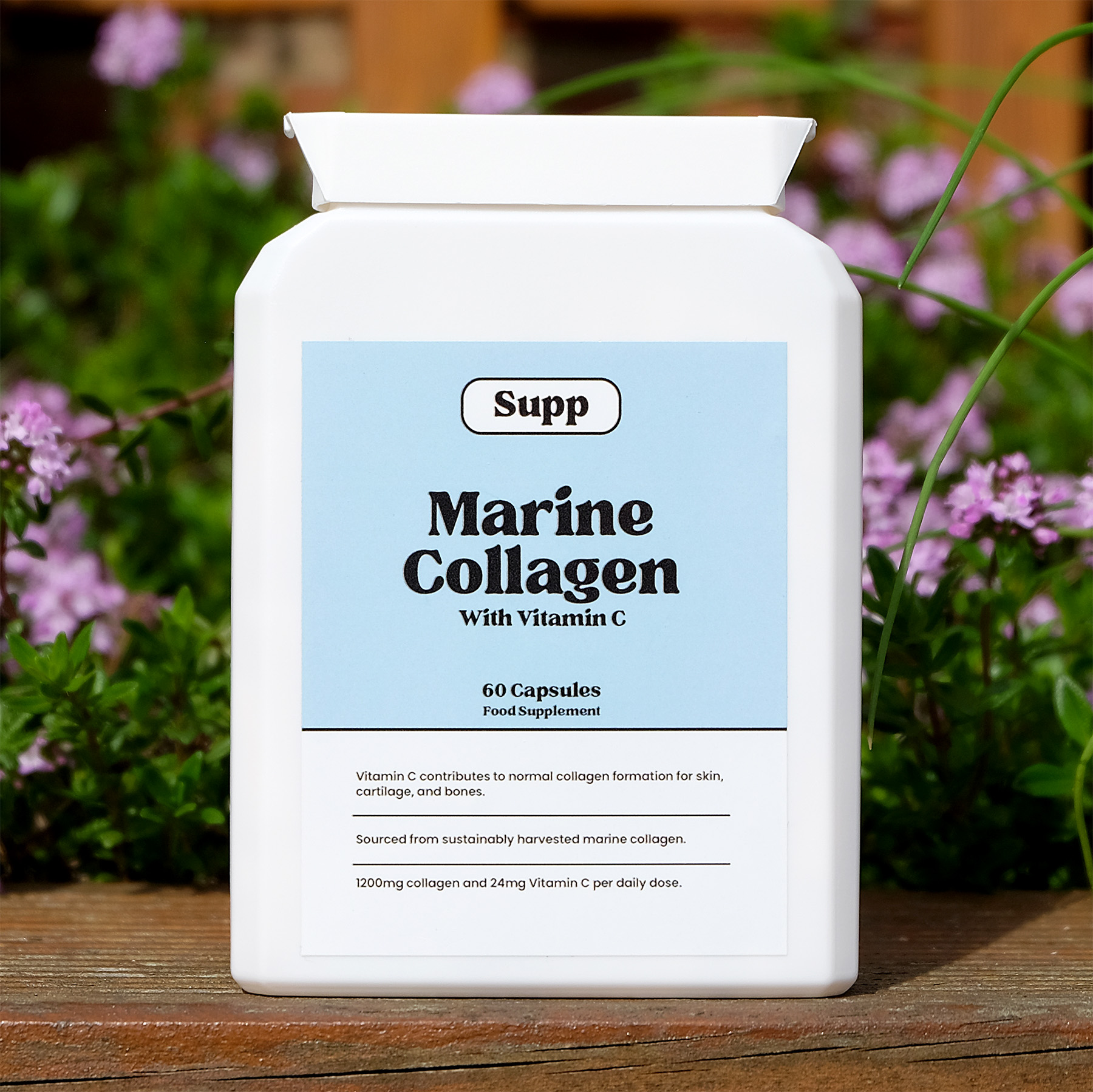
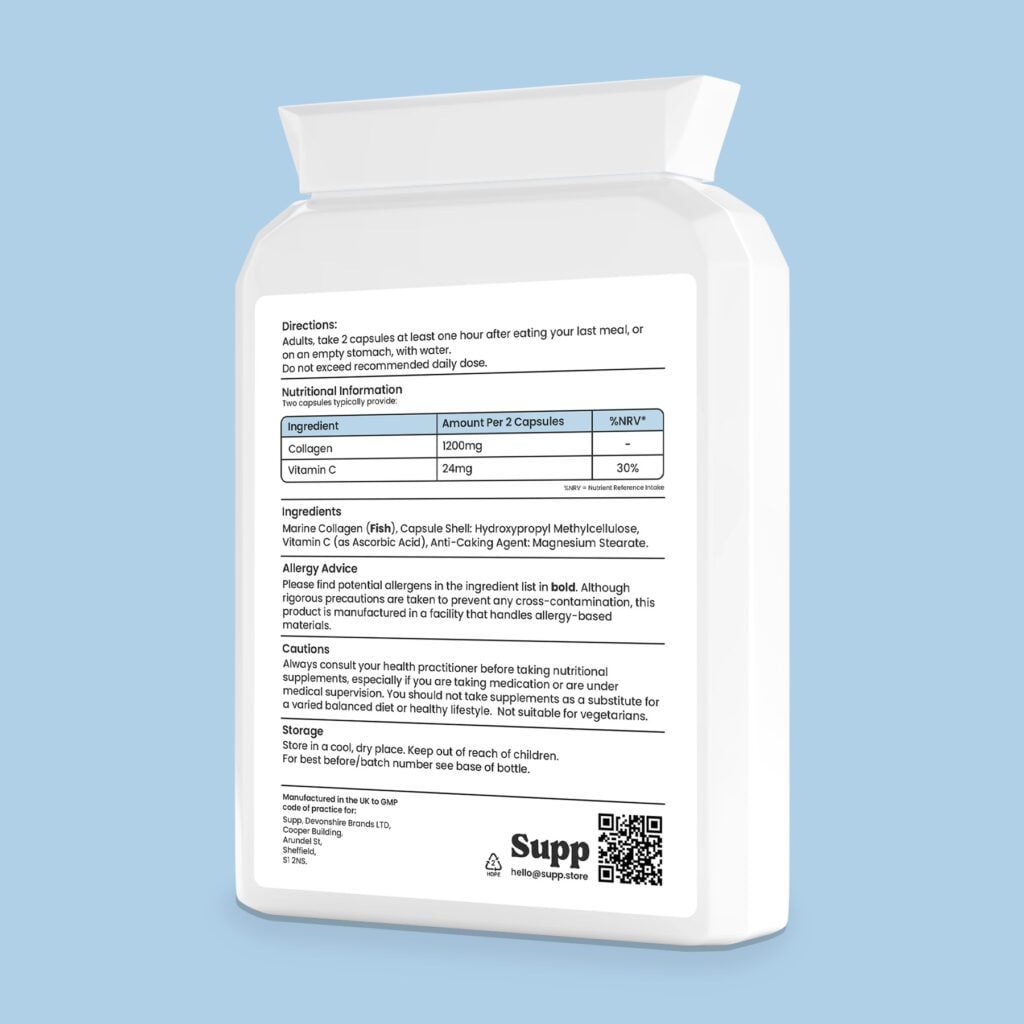
Our Marine Collagen delivers 1,200mg of hydrolysed marine collagen per two-capsule serving, alongside 24mg of vitamin C (30% NRV), with everything clearly labelled so you know exactly what you’re getting.
3. Vitamin C in the formula
Your body can’t produce new collagen without vitamin C. It’s an essential cofactor in the collagen synthesis process, which means it needs to be present for the biological reaction to take place at all [6].
A marine collagen supplement that includes vitamin C takes care of this for you. One that doesn’t means you need to make sure you’re getting enough from your diet or another supplement, ideally taken at a similar time of day.
This is also reflected in EFSA-approved health claims in the UK and EU. Vitamin C has an approved claim for contributing to normal collagen formation for the normal function of skin. Collagen alone does not carry this approved claim as a standalone ingredient.
We’ve written about why collagen and vitamin C work so well together if you want the full picture.
4. Source transparency and sustainable sourcing
Marine collagen is derived from fish, which immediately raises a question worth asking: where do those fish come from, and how were they sourced?
Sustainably sourced marine collagen typically comes from wild-caught or responsibly farmed fish, using parts that would otherwise go to waste. Reputable brands will tell you this openly. The source of the fish, and sometimes the specific species, should be stated somewhere on the label or product page.
This matters for environmental reasons, but it also matters for quality. Fish sourced from cleaner, better-managed waters and processed under tighter controls are less likely to carry contaminants. If a brand isn’t forthcoming about where their collagen comes from, that’s worth noting.
At Supp, we believe in transparent labelling across the board. You should know exactly what you’re taking and where it came from. Our full marine collagen ingredient page breaks down what’s inside.
5. UK-made and GMP certified
This one applies to every supplement you buy, not just collagen, but it’s worth repeating because it’s easy to overlook when you’re focused on ingredients.
GMP stands for Good Manufacturing Practice. It’s a set of quality and safety standards that manufacturing facilities are audited against. In the UK, GMP-certified supplement production also sits under Food Standards Agency oversight. Together, these standards are designed to ensure that what’s printed on the label is what’s actually in the capsule, at the stated dose, and free from contamination.
Without this certification, there’s no independent verification of what you’re actually getting. A label can say anything.
UK-made supplements also have an additional layer of accountability under UK regulations. It’s one of the reasons we manufacture right here in the UK rather than importing from markets where standards can vary widely.
What to avoid
A few patterns to watch out for when you’re comparing products:
Unlisted collagen type. If a label says “marine collagen” without specifying it’s hydrolysed, or without listing the collagen type, you’re missing important information about whether it’s likely to work as expected.
Dose that doesn’t add up. Check the per-serving figure, not just the per-capsule one. Some products show a large number on the front but base it on a serving size of four or more capsules a day. Make sure the recommended daily dose is realistic for your routine.
Vitamin C not included. Not a dealbreaker, but means you need to source it separately. If you’re already taking a vitamin C supplement or eating plenty of citrus, this matters less. If not, a combined formula is simpler.
Vague sourcing claims. Phrases like “wild caught” or “sustainably sourced” without any further detail are easy to put on a label. Look for specifics, or at least a brand that takes its sourcing seriously enough to explain it.
Promised results that sound too good. Reputable science shows real, if moderate, improvements in skin hydration and elasticity with consistent use over 8-12 weeks [4][7]. Anyone claiming you’ll see dramatic changes within days is stretching the evidence significantly. We’d always rather be honest with you than oversell.
What does the science actually say?
It’s worth being straight with you here. The evidence for marine collagen is genuinely encouraging, particularly for skin, but the results from clinical trials are visible after consistent use over a few weeks, not overnight miracles..
A 2025 systematic review and meta-analysis found that oral collagen supplementation significantly improved skin hydration and elasticity compared to placebo across a pool of clinical trials [4]. Fish-derived collagen in particular showed positive results for hydration.
A placebo-controlled clinical trial published in 2024 found improvements in skin hydration, elasticity, wrinkles and hair condition following 12 weeks of daily hydrolysed collagen supplementation [5].
A review of hydrolysed marine collagen published via PMC found improvements across multiple skin parameters over 12 weeks, including skin elasticity up 23% compared to placebo, hydration up 14%, and firmness up 25% based on self-reported scores [7]. A 2023 double-blind, placebo-controlled trial also found reductions in wrinkle depth after 90 days of oral marine collagen intake [7].
The mechanism is consistent: hydrolysed collagen peptides signal fibroblast cells to produce more collagen, elastin and hyaluronic acid. The results take time, typically 8-12 weeks of daily use to become noticeable.
If you’re also curious about whether topical collagen products do anything similar, our article on collagen creams vs oral collagen covers that comparison properly.
Capsules, powders or liquids: which form is best?
There’s no objectively right answer here. Each format has trade-offs.
Capsules are the most convenient and tasteless option. No mixing, no measuring, just take them and get on with your day. A well-formulated two-capsule daily serving can deliver a meaningful amount of hydrolysed collagen alongside supporting nutrients like vitamin C, in a format most people will actually stick to.
Powders can deliver higher doses per serving and are versatile enough to add to drinks or food. The downside is that unflavoured marine collagen powder can have a mild marine taste, and there’s a preparation step involved.
Liquid collagen is often pre-dosed and easy to take, though products in this format tend to carry a price premium and can involve flavourings and additives worth checking.
For most people who want something they’ll actually stick to every day, capsules win on convenience. That’s why we formulated our Marine Collagen in capsule form, GMP certified and made in the UK, with nothing unnecessary added.
A quick note on realistic expectations
Collagen supplements aren’t a quick fix. They work by gradually supporting your body’s own collagen production, which takes time to become visible.
Most people who see a difference report it after 8-12 weeks of consistent daily use. Skin hydration often improves before elasticity, and nail strength tends to be one of the earlier changes people notice.
It’s also worth remembering that collagen production is affected by lifestyle factors too. Sun exposure accelerates collagen breakdown, poor sleep slows tissue repair, and smoking has a significant negative effect on collagen levels. A supplement works best as part of a routine that supports your skin from multiple angles.
Curious about what’s actually happening in your body when you take collagen? Our guide to what marine collagen is and how it works covers the biology.
Summary
Looking for the best marine collagen supplement UK shoppers can trust doesn’t have to be complicated, once you know what to look for.
The five things that matter most:
- Hydrolysed collagen peptides, so your body can actually absorb it
- A meaningful daily dose, consistent daily use at a dose your body can actually absorb
- Vitamin C included, for collagen synthesis to work properly
- Transparent sourcing, so you know where the collagen comes from
- UK-made and GMP certified, for verified quality and dose accuracy
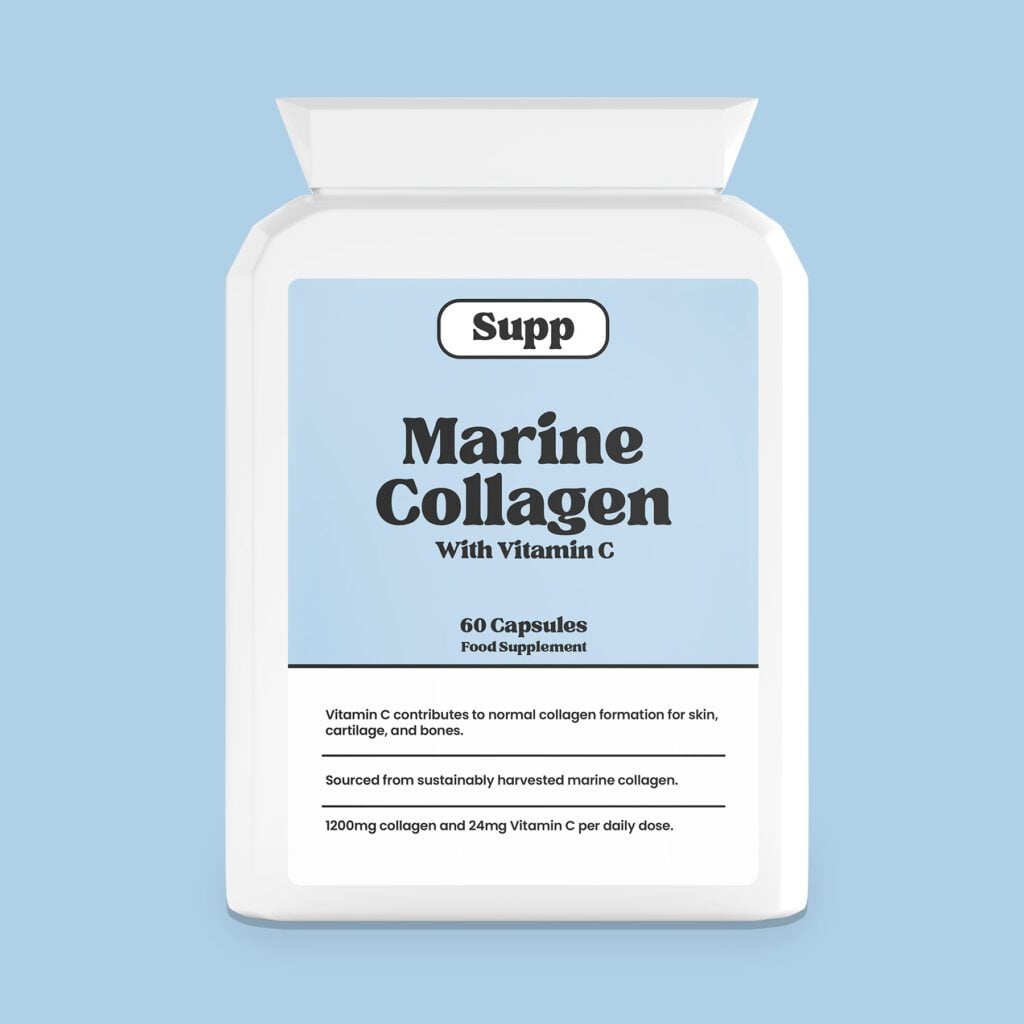
If you’d like to see how our Marine Collagen capsules stack up against those criteria, the full product page has everything you need. No hidden blends. No wild promises. Just a straightforward supplement made to the standard you should expect.
References
- Geahchan S, Baharlouei P, Rahman A. 2022. Marine collagen: a promising biomaterial for wound healing, skin anti-aging, and bone regeneration. Marine Drugs. https://pubmed.ncbi.nlm.nih.gov/35049916/
- Coppola D, Oliviero M, Vitale GA, et al. 2020. Marine collagen from alternative and sustainable sources: extraction, processing and applications. Marine Drugs. https://pmc.ncbi.nlm.nih.gov/articles/PMC7230273/
- Sibilla S, Godfrey M, Brewer S, et al. 2015. An overview of the beneficial effects of hydrolysed collagen as a nutraceutical on skin properties: scientific background and clinical studies. Open Nutraceuticals Journal. https://www.researchgate.net/publication/276696375
- Danessa G, Notario D, Regina R. 2025. Effects of collagen-based supplements on skin’s hydration and elasticity during ageing: a systematic review and meta-analysis. Indian Journal of Dermatology, Venereology and Leprology. https://ijdvl.com/effects-of-collagen-based-supplements-on-skins-hydration-and-elasticity
- Reilly DM, Kynaston L, Naseem S, et al. 2024. A clinical trial shows improvement in skin collagen, hydration, elasticity, wrinkles, scalp and hair condition following 12-week oral intake of a supplement containing hydrolysed collagen. Journal of Cosmetic Dermatology. https://pmc.ncbi.nlm.nih.gov/articles/PMC11254459/
- Pullar JM, Carr AC, Vissers MCM. 2017. The roles of vitamin C in skin health. Nutrients. https://pubmed.ncbi.nlm.nih.gov/28805671/
- Sibilla S, Fleck A. 2025. Hydrolyzed marine collagen: emerging evidence of benefits via the oral route. Clinical, Cosmetic and Investigational Dermatology. https://pmc.ncbi.nlm.nih.gov/articles/PMC12701666/
Disclaimer
This article is for informational purposes only and does not constitute medical advice. If you have a medical condition, are pregnant, breastfeeding, or are taking medication, please consult your GP or a qualified health professional before adding any supplement to your routine.