

You’ve started taking collagen. You’re taking it most days, you’re hopeful, and a few weeks in you find yourself in front of the mirror thinking… is this actually doing anything?
It’s one of the most common questions we get, and the honest answer is that collagen can do a lot for how your skin looks and feels over time, but only when a few things are in place. It needs to be the right kind. It needs a partner nutrient to finish the job. And it needs time.
Our co-founder Olivia, a biomedical science graduate, breaks all of this down in the short video below. She sketches out why the size of your collagen matters, and why she compares collagen and vitamin C to a well made brick wall. Have a watch, then read on for the detail:
Why the size of your collagen matters
Collagen is the most abundant protein in your body. Think of it as the scaffolding that keeps skin firm, joints comfortable and connective tissue strong. The catch is that your natural production starts to slow from your mid-20s, which is why a lot of people look to top it up later on.
Here’s the part that gets skipped. When you swallow collagen in its whole form, it’s far too large for your body to use as it is. It has to be broken down first.
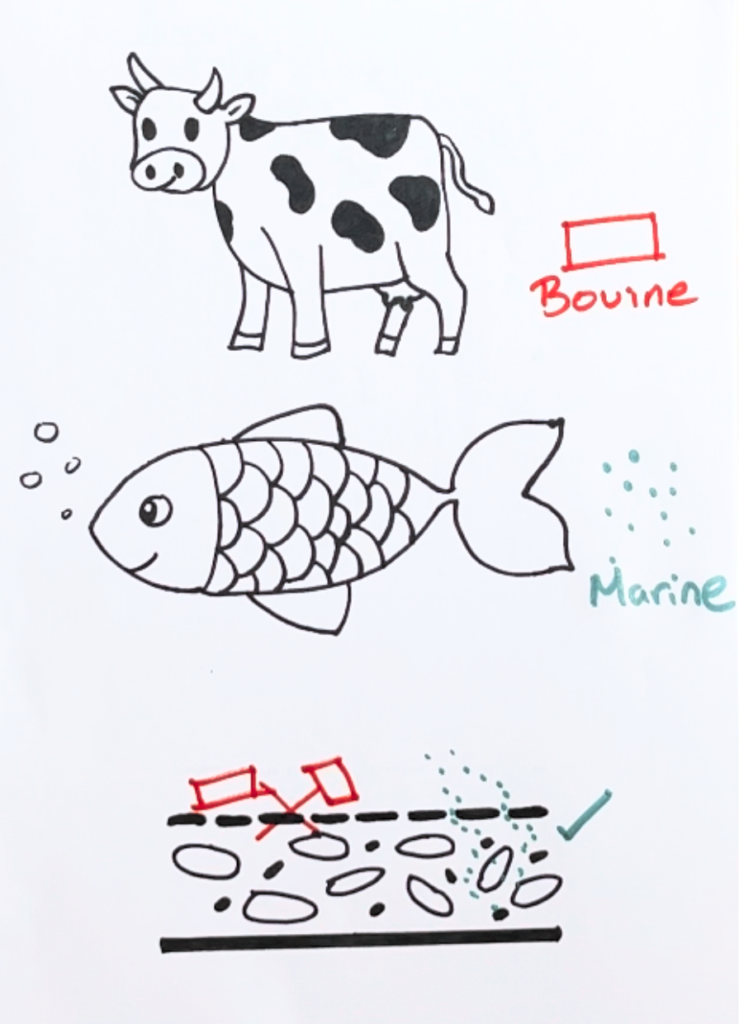
That’s where hydrolysed collagen comes in. Hydrolysed simply means the collagen has already been broken down into small fragments called peptides, so your body has less work to do. Marine collagen is type 1, the same type that makes up most of the collagen in your skin, and it’s naturally one of the lowest molecular weight collagens around. Basically, the peptides are small.
This is exactly what Olivia draws out in the video. Larger collagen molecules are clunky and harder for your body to take up, while the smaller peptides in hydrolysed marine collagen are sized to be absorbed more easily.
The research supports the principle. After you take hydrolysed collagen, small collagen-derived peptides such as Pro-Hyp can be detected in the bloodstream within one to two hours [1]. That’s the raw material making its way to where your body can put it to use.
It’s why we chose hydrolysed marine collagen for our Marine Collagen capsules, rather than a heavier, harder-to-absorb option. If you want the full head-to-head on sources, we cover it in Marine vs Bovine Collagen and What Is Marine Collagen?.
The bit most people miss: vitamin C
This is where most collagen routines quietly fall short. You can take the finest collagen in the world, but without vitamin C, your body can’t actually finish building with it.
Olivia’s analogy in the video says it better than any textbook. Picture building a brick wall. The collagen peptides are your bricks. Vitamin C is the mortar. You can lay every brick perfectly, but with nothing to bind them together, the wall won’t hold. No mortar, no structure.
So what’s happening underneath? Your body makes its own collagen using amino acids as the building blocks. Vitamin C acts as a cofactor, which is just a helper that certain enzymes need in order to work. Two key enzymes rely on vitamin C to lock the collagen structure into its strong, stable, properly formed shape [2]. Take the vitamin C away and that step doesn’t run properly.
This is also why vitamin C carries one of the few officially authorised health claims in this space: vitamin C contributes to normal collagen formation for the normal function of skin. The same goes for your bones, cartilage, gums, teeth and blood vessels.
Put simply: collagen hands your body the bricks, and vitamin C helps it build the wall.
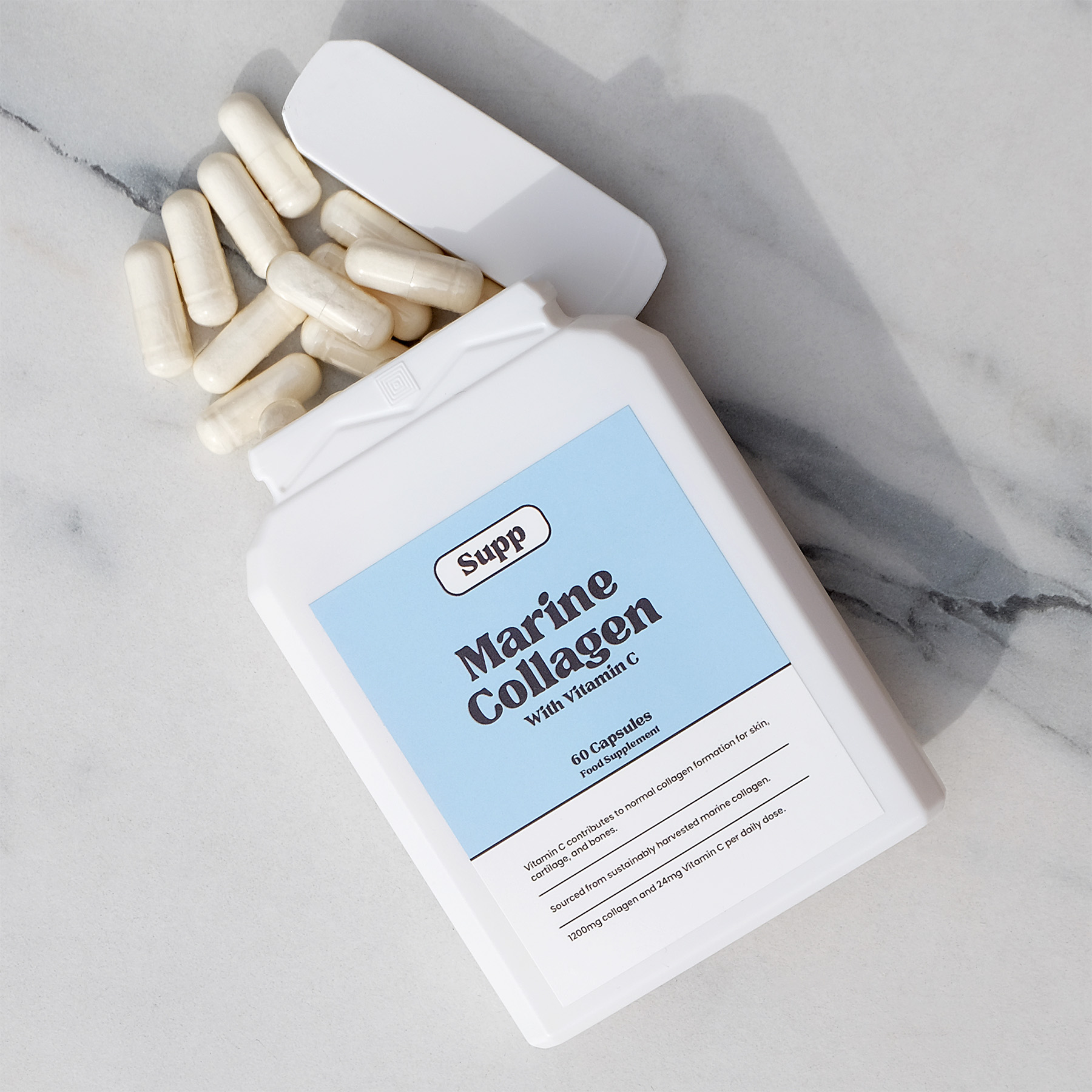
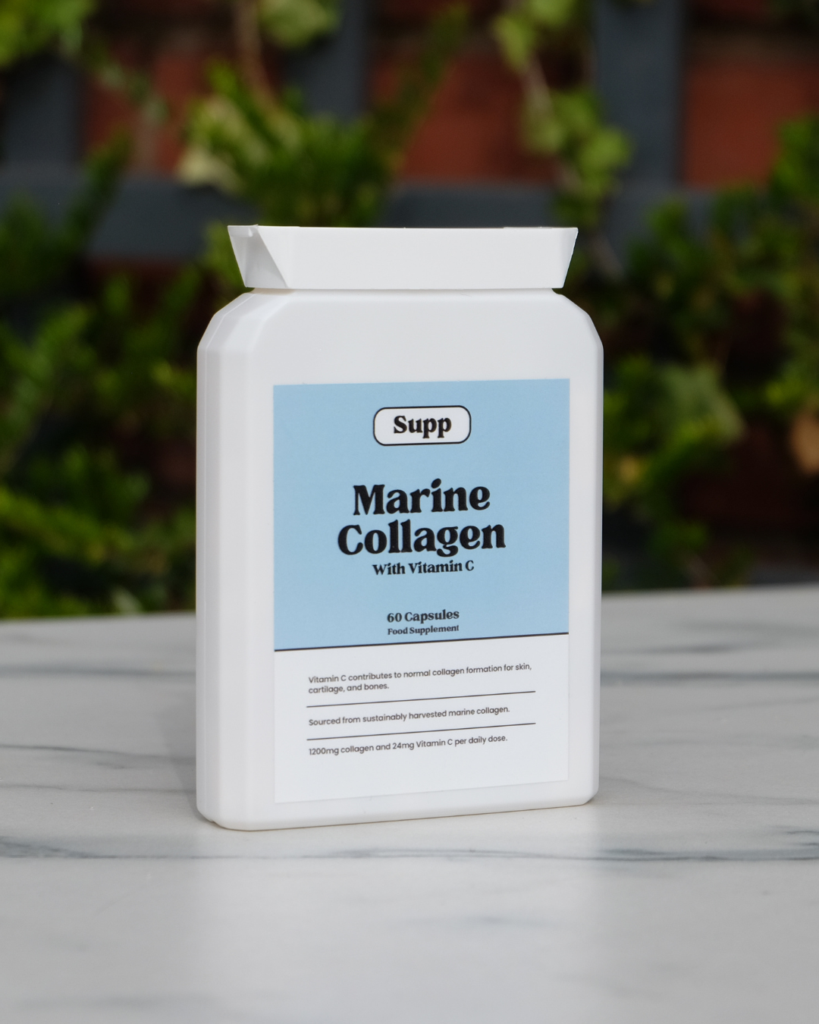
That’s the reason we didn’t leave it to chance. Every daily serving of Supp Marine Collagen includes vitamin C (24mg, which is 30% of your daily reference intake) sitting alongside 1,200mg of marine collagen peptides. You get the bricks and the mortar in the same capsule, so you’re never accidentally doing half the job.
You can top up your vitamin C from food too. Peppers, citrus fruits, berries and leafy greens are all good sources, and we get into why in How Citrus Powers Your Wellbeing.
How long does collagen take to work?
The honest answer, and the one that saves you wasting money, is this: not overnight.
Collagen works at the pace your body renews its own tissue, and that pace is slow. You’re supporting a gradual process, not flipping a switch. So if you’ve taken it for ten days and seen nothing in the mirror, that’s completely normal. You haven’t done anything wrong, and the product isn’t failing you.
In the video, Olivia points to a window of around 6 to 8 weeks as the point where you can reasonably start expecting to notice a difference. That lines up neatly with the research. The well-known skin studies tend to measure changes from around the 8 week mark, with many trials running for 8 to 12 weeks. One placebo-controlled study looking at skin elasticity assessed results over an 8 week period [3], while another following skin moisture and the dermal collagen network ran across a similar 8 to 12 week timeframe [4].
The takeaway is to give it a proper run. Commit to at least 8 weeks of daily use before you decide whether it’s working for you. Anything shorter and you simply haven’t given your body long enough to show you.
How to get the most from your collagen
A few simple habits make the difference between a routine that works and one that fizzles out:
- Take it daily. Same time each day, ideally at least an hour after eating or on an empty stomach. Building it into an existing habit (your morning coffee, brushing your teeth) makes it stick.
- Make sure vitamin C is in the mix. Ours includes it, so you’re sorted. If you’re using a plain collagen, pair it with a vitamin C source such as our Vegan Multivitamin & Mineral, or vitamin C rich foods.
- Give it at least 8 weeks. Patience is part of the method here, not a nice-to-have.
- Support it with the basics. A protein-rich diet, plenty of water, decent sleep and sensible sun protection all help your skin do its part.
- Choose a transparent product. We list exactly what’s in every dose, with no hidden blends to hide behind. It’s made in the UK to GMP standards, so you know what you’re taking and why.
What if you don’t eat fish?
Marine collagen is sourced from fish, so it isn’t suitable if you’re vegan or vegetarian. If that’s you, you can still look after your skin from the inside using nutrients like vitamin C, which plays the same collagen-supporting role we talked about above. Our Vegan Multivitamin & Mineral is a sensible starting point, and you can browse the rest of our Skin, Hair & Nails range for fish-free options.
To Conclude
Collagen isn’t a magic pill, and we’d never sell it as one. But get three things right and you’re giving your skin genuine support, the way the research suggests it works best: small, absorbable peptides, the vitamin C needed to put them to use, and a bit of patience.
Supp Marine Collagen handles the first two for you in a single daily capsule. The patience is the part we’ll leave with you.
Always consult your health practitioner before use, particularly if you’re pregnant, breastfeeding or taking medication.
References
- Iwai K, Hasegawa T, Taguchi Y, et al. 2005. Identification of food-derived collagen peptides in human blood after oral ingestion of gelatin hydrolysates. Journal of Agricultural and Food Chemistry. https://pubmed.ncbi.nlm.nih.gov/16076145/
- Pullar JM, Carr AC, Vissers MCM. 2017. The Roles of Vitamin C in Skin Health. Nutrients. https://pubmed.ncbi.nlm.nih.gov/28805671/
- Proksch E, Segger D, Degwert J, et al. 2014. Oral supplementation of specific collagen peptides has beneficial effects on human skin physiology: a double-blind, placebo-controlled study. Skin Pharmacology and Physiology. https://pubmed.ncbi.nlm.nih.gov/23949208/
- Asserin J, Lati E, Shioya T, Prawitt J. 2015. The effect of oral collagen peptide supplementation on skin moisture and the dermal collagen network. Journal of Cosmetic Dermatology. https://pubmed.ncbi.nlm.nih.gov/26362110/