


If you have ever dealt with urinary discomfort, you will know how quickly it can knock your day off track. It is also one of those areas where people often want support options that feel straightforward, gentle, and easy to build into a routine.
D-mannose is one of the most talked about ingredients for urinary health support, especially among people who experience recurring UTI symptoms. But what is it, how does it work, and what should you realistically expect?
This guide explains D-mannose, including how it may support urinary health, what the wider evidence says, and when it is important to speak to a clinician.
What Is D-Mannose?
D-mannose is a naturally occurring sugar that is similar in structure to glucose. It is found in small amounts in some fruits, and it is also used as a supplement.
People typically take D-mannose to support urinary tract health, especially when they are prone to recurring bladder discomfort.
It is not an antibiotic. It is not a painkiller. And it is not a guaranteed fix. Instead, the idea is that it can support the body’s natural ability to flush out certain bacteria.
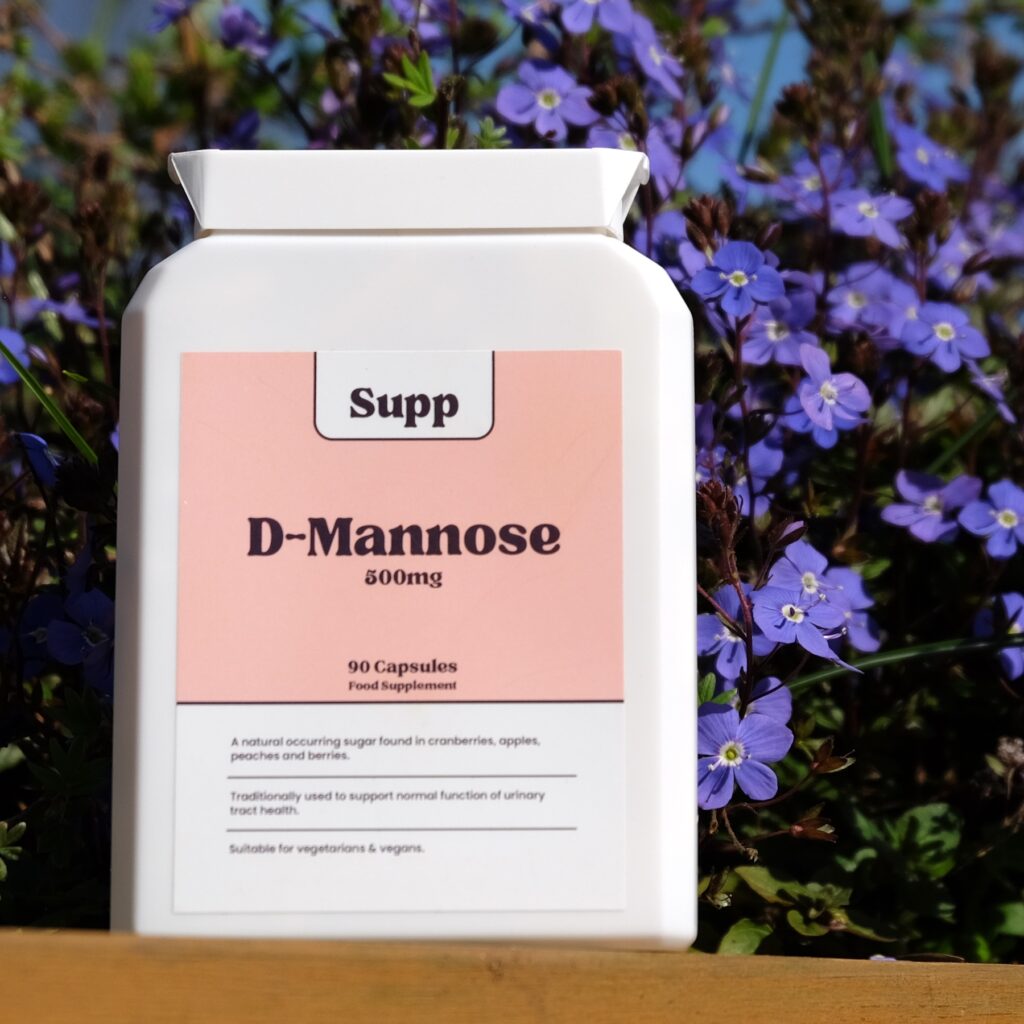
If you want to see how we use it, you can view our D-mannose supplement here: Our D-Mannose Supplement.
Why Urinary Issues Can Keep Coming Back
Your urinary tract includes your kidneys, ureters, bladder, and urethra. It is the system that makes, stores, and passes urine.
Many urinary tract infections, particularly bladder infections (cystitis), are linked to bacteria entering the urinary tract and multiplying.
One of the most common culprits is E. coli, a bacteria that normally lives in the gut. Problems can start when it ends up in the wrong place.
Some people are more prone to recurrence. Common contributing factors include:
- Anatomy (a shorter urethra can make it easier for bacteria to reach the bladder)
- Sex and friction
- Dehydration (less urine flow means less natural flushing)
- Menopause-related changes
- Holding urine for long periods
- Certain contraceptives (for example, diaphragms or spermicides)
If you recognise yourself in that list, it explains why “support” often focuses on helping the urinary tract stay clear, rather than only reacting once symptoms are already intense.
How D-Mannose Can Support Urinary Health
The main theory behind D-mannose is about bacterial “sticking”.
Certain strains of E. coli have tiny hair-like structures (often discussed as type 1 fimbriae) that help them latch onto the lining of the urinary tract [1]. A key part of this binding involves a protein called FimH, which can attach to mannose-like structures on cells in the urinary tract.
Here’s how D-mannose can help:
- Some bacteria try to cling to the bladder wall
- D-mannose can act like a decoy
- Bacteria bind to the D-mannose instead
- They are then more likely to be flushed out when you urinate
This is often described as an “anti-adhesion” approach rather than a bacteria-killing approach.
Mechanistic research discusses the mannose binding behaviour of FimH and how that relates to bacterial adhesion.
That said, biology is rarely one-size-fits-all. Not every urinary infection is caused by the same bacteria, and not every E. coli behaves in the same way. This is one reason outcomes can vary between people.
What Does The Evidence Say About D-Mannose?
If you have looked into D-mannose before, you have probably noticed two things:
- Many people swear by it
- Evidence summaries often describe it as promising but not ‘definitive’
A well-known clinical trial on D-Mannose for recurrent UTIs included 308 women with a history of recurrent UTIs. They were assigned to one of three groups for six months.: D-Mannose, Nitrofurantoin (a commonly used antibiotic for UTI’s), or no preventative support [2].
Out of all 3 groups, the proportion of women who experienced a recurrence was lower in the D-mannose group (14.6%) compared with the no support group (60.8%), and also lower than the nitrofurantoin group (20.4%).
The authors concluded D-mannose reduced recurrence risk in their population and performed similarly to the antibiotic comparator.
It is also referenced within NICE guidance as the key evidence supporting D-mannose as a self care option for some people with recurrent UTI [3].
The European Association of Urology also includes D-mannose as an option for reducing recurrent cystitis episodes, but highlights that the overall evidence base is limited and results are mixed [4].
The practical takeaway is this: D-mannose has a plausible mechanism and supportive clinical evidence, but results can vary and it should be seen as support rather than a guaranteed outcome.
Who Might Consider D-Mannose?
D-mannose is most commonly used by adults who:
- are prone to recurring urinary discomfort or UTI-like symptoms
- want a non-antibiotic option to support urinary health
- notice clear triggers and want support for those days – for example sex, travel, dehydration, long days where they cannot easily use the loo
- have had UTIs confirmed as E. coli in the past
- want a preventative-first approach, focusing on reducing recurrence rather than only reacting once discomfort hits
Who Should Be Cautious, Or Seek Medical Advice First
Urinary symptoms are not always straightforward, and some situations need proper clinical input. Speak to a pharmacist or GP before using supplements if you:
- are pregnant or breastfeeding
- have diabetes or are managing blood sugar (D-mannose is a sugar, even though it is not used the same way as glucose)
- have kidney disease, frequent kidney infections, or other known urinary tract problems
- are immunocompromised
- are buying for a child
If in doubt, it is always better to ask. Urinary issues can become serious if the infection moves beyond the bladder.
How To Take D-Mannose
D-mannose supplements come in powders and capsules. Powders are often used in studies because they make it easier to deliver gram-level servings, but capsules can be a more convenient option day to day.
If you are comparing products, focus on the actual D-mannose amount per serving and how many capsules make up a full serving. Then follow the label directions for the product you choose.
A couple of basics still matter whichever format you use:
- Take it consistently if you are using it as ongoing support
- Stay well hydrated, as regular urine flow is part of the body’s natural flushing process
If you want more details on D-Mannose as an ingredient, you can read more on our D-Mannose Ingredient Information Page.
Everyday Habits That Support Urinary Health
Supplements work best when they sit on top of the basics.
Here are simple habits that genuinely matter for urinary health:
- Drink enough water to keep urine a pale yellow
- Do not hold urine for long periods
- Urinate after sex (many people find this helpful)
- Avoid heavily fragranced soaps or products if you are prone to irritation
- Choose breathable underwear, especially during workouts
If you are post-menopausal and dealing with recurring symptoms, it is worth discussing this with your GP. Hormonal changes can affect the urinary tract and vaginal tissue, which can influence recurrence risk.
When To Speak To A GP
Do not try to “push through” urinary symptoms if red flags are present.
Seek medical advice urgently if you have:
- Fever, chills, or feel unwell
- Pain in your back or side (flank pain)
- Blood in your urine
- Nausea or vomiting
- Symptoms that are severe, worsening, or not improving quickly
If you keep getting UTIs, it is also worth speaking to a GP about recurrent UTI management. The NHS advises seeing a GP if UTIs keep coming back, including patterns like multiple infections in a shorter period [5].
FAQ’s about D-Mannose
Here’s some common questions we get asked when people are looking at starting D-Mannose:
1. Can I take D-mannose every day?
Many people use it as a daily routine, particularly if they are prone to recurrence. Follow your label directions and speak to a clinician if you have medical conditions or take regular medication.
2. How quickly does D-mannose work?
D-mannose is best thought of as a preventative support, rather than something to rely on once symptoms have started. It is not a painkiller and it is not designed to give instant relief, so it is best used daily, and consistently.
3. Is D-mannose an antibiotic?
No. It is not designed to kill bacteria. The common explanation is that it may help reduce bacterial adhesion so the body can flush bacteria out in urine.
4. What if my symptoms keep coming back?
Recurring urinary symptoms deserve proper attention. A GP can look at triggers, confirm infection type, rule out other causes, and discuss prevention strategies.
Our Approach At Supp:
At Supp, we focus on the basics done properly: evidence-led ingredients, transparent labelling, and consistently high manufacturing standards. If you want to see how our supplements are made and checked for quality, take a look at how we handle Manufacturing & Quality Standards.
References:
- Sauer MM, Jakob RP, Eras J, et al. 2016. Catch-bond mechanism of the bacterial adhesin FimH. Nature Communications. https://www.nature.com/articles/ncomms10738
- Kranjčec B, Papeš D, Altarac S. 2014. D-mannose powder for prophylaxis of recurrent urinary tract infections in women: a randomised clinical trial. World Journal of Urology. https://pubmed.ncbi.nlm.nih.gov/23633128/
- NICE. Urinary tract infection (recurrent): antimicrobial prescribing (NG112). https://www.nice.org.uk/guidance/ng112/resources/urinary-tract-infection-recurrent-antimicrobial-prescribing-pdf-66141595059397
- European Association of Urology (EAU). EAU Guidelines on Urological Infections: The guideline. https://uroweb.org/guidelines/urological-infections/chapter/the-guideline
- NHS. Urinary tract infections (UTIs). https://www.nhs.uk/conditions/urinary-tract-infections-utis
Disclaimer:
This article is for general information only and is not a substitute for medical advice. If you have urinary symptoms, are pregnant, have a medical condition, or take regular medication, speak to a pharmacist or GP before using supplements.