
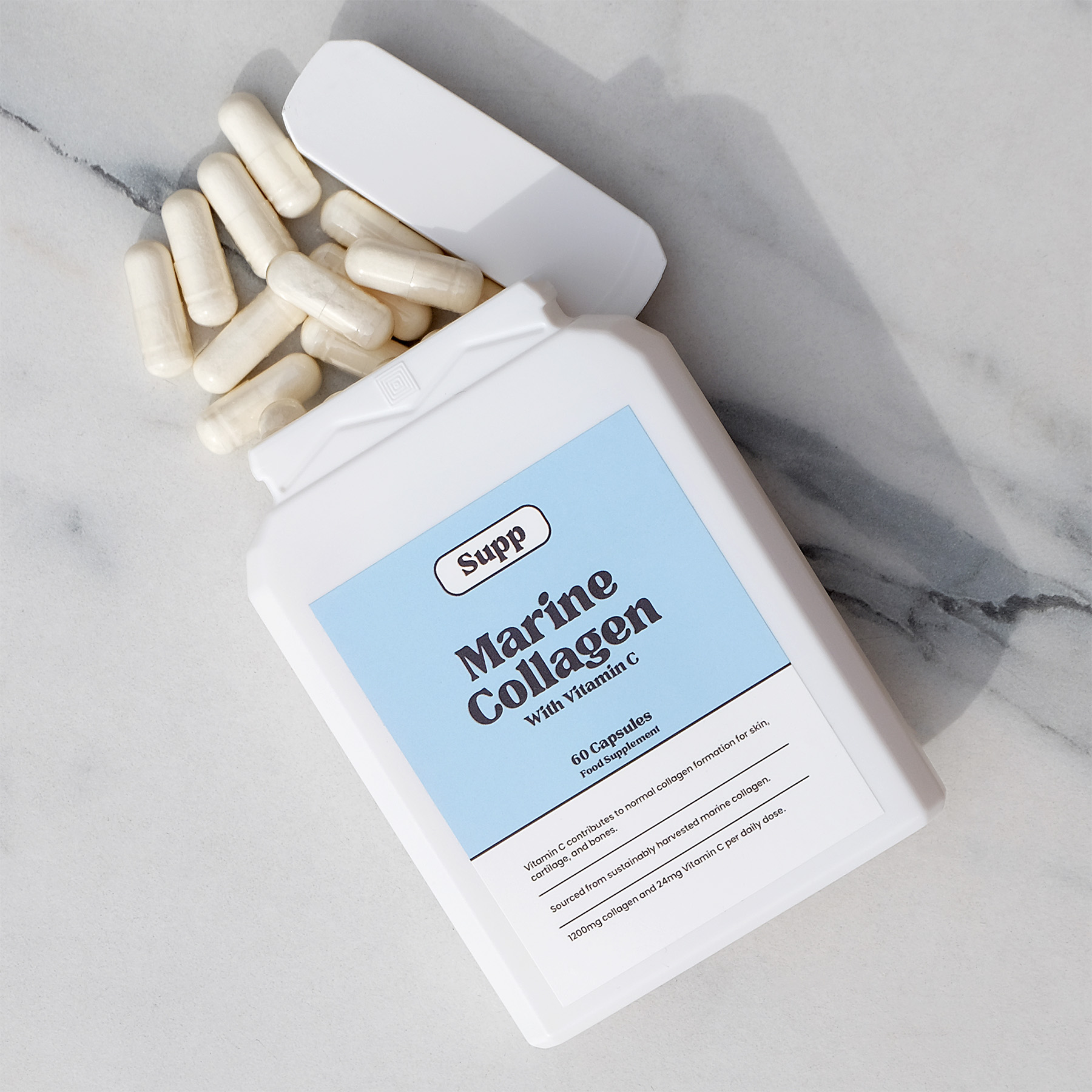



If you’ve been seeing Marine Collagen everywhere and wondering what it is and whether it’s worth taking, you’re in the right place.
“Collagen” is one of those words that gets thrown around in beauty and wellness, but the details often get lost behind overpromises or marketing hype.
In this guide, we’ll break down:
- What marine collagen is made from
- How it behaves in the body
- What the scientific research says
- How to choose a marine collagen supplement that’s right for you
What Is Marine Collagen?

Marine Collagen is collagen that’s sourced from fish, typically from the skin, scales, or bones.
Collagen itself is a structural protein that helps form the framework of connective tissues, including skin, tendons, cartilage, and bones.
There are many different types of collagen, but the big ones are:
- Type I: found heavily in skin, tendons, bone
- Type II: found mainly in cartilage
- Type III: found alongside type I in skin and blood vessels
Most marine collagen supplements are rich in type I collagen, which is one reason they’re commonly marketed for skin support.
You’ll usually see marine collagen sold as either:
- Hydrolysed collagen (collagen peptides): collagen broken down into smaller peptides
- Gelatine: partially broken down collagen, often used in food
For supplements, hydrolysed collagen peptides are the most common form because they’re easier to mix, digest, and use consistently.
What Is Marine Collagen Made From?
Marine collagen is typically extracted from fish by-products that would otherwise go to waste. These raw materials are then processed, purified, and often hydrolysed into smaller peptides for use in supplements.
How this process is handled matters for two main reasons. First, quality and safety depend heavily on sourcing, purification, and testing standards. Second, the final form of the collagen, such as peptides or gelatine, affects how easy it is to use consistently as part of a daily routine.
If you want a quick “trust check”, look for brands that clearly state:
- The form (hydrolysed/collagen peptides)
- Allergen information (fish)
- Manufacturing standards and testing
How Does Marine Collagen Work In The Body?
Collagen doesn’t travel straight to your skin in one piece. When you take it, your gut breaks it down into smaller building blocks (amino acids) and tiny collagen fragments (peptides).
Those peptides can show up in the bloodstream, and research suggests they can help support the body’s normal collagen turnover by acting as both raw materials and gentle “signals” for connective tissue maintenance (1).
A simple way to think about it:
- Collagen provides building blocks your body can use (amino acids like glycine and proline)
- It can also provide small peptides that help support normal connective tissue maintenance over time.
So rather than “collagen turns straight into collagen”, it’s better to think of collagen peptides as supporting the body’s normal collagen processes, alongside a balanced diet and healthy lifestyle.
What Does The Research Say About Marine Collagen and Skin?
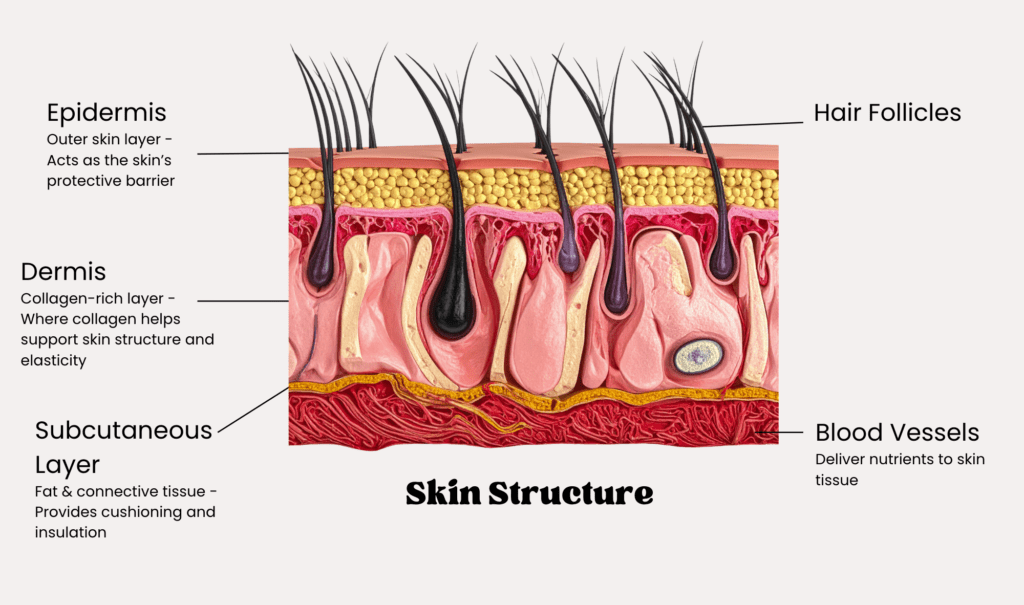
Collagen is most concentrated in the dermis, the middle layer of the skin, where it helps support structure, elasticity, and hydration. This is why the strongest human evidence for collagen supplementation relates to skin health.
Most studies look at hydrolysed collagen peptides (including fish-derived options) and measure changes such as skin hydration, elasticity, and the appearance of wrinkles.
These changes reflect improvements in how the skin holds water and maintains its structure, rather than just surface-level cosmetic effects.
Across several randomised, placebo-controlled trials, people taking collagen peptides daily typically see small improvements across all of these measures over 8 to 12 weeks.
Looking at the Evidence Across Multiple Studies
To get a more reliable “big picture”, researchers often pull together data from lots of human trials into what’s called a meta-analysis. It cross-checks and combines results across studies, helping show the overall trend, not just what happened in one small trial.
When researchers do this for collagen and skin health, the findings are broadly consistent:
- A 2023 meta-analysis found that oral collagen supplementation was associated with improvements in skin hydration and elasticity across multiple studies, while noting that study quality, collagen type, and dosing varied (2).
- A 2025 meta-analysis also reported improvements in hydration, elasticity, and wrinkle appearance across randomised controlled trials (3).
A few things to keep in mind:
- Studies use different collagen sources, peptide sizes, doses and added ingredients, so results will not be identical across all collagen products.
- Expect noticeable but modest changes over time, not a dramatic transformation overnight.
- Collagen works best as a supporting tool for skin health, alongside the fundamentals like adequate protein intake, vitamin C, good sleep, and sun protection.
Does Marine Collagen Support Joints, Cartilage and Mobility?
Collagen is a natural part of cartilage and connective tissue, so it’s no surprise that many people look at collagen supplements for joint comfort and mobility.
The research here is more mixed than it is for skin, but some human studies suggest that collagen peptides can help support joint comfort and physical function in people with osteoarthritis, particularly when taken consistently over time (4).
Results vary between individuals, and collagen should be seen as part of a broader joint-care approach rather than a standalone solution.
An important distinction to understand
“Joint collagen” isn’t one single thing, and this often causes confusion.
- Some products use type II collagen, often in an undenatured form, which is studied separately for immune-related joint pathways.
- Others use collagen peptides, usually derived from type I collagen, which are broken down and used more generally by the body.
These forms work differently, and studies on one type can’t automatically be applied to the other. If joint support is your main goal, it’s worth checking that a product specifically contains type II collagen, rather than assuming all collagen supplements target joints in the same way.
What else matters for joint support?
Collagen is only one piece of the picture. Joint comfort and mobility are also influenced by:
- Regular movement and strength training, which help maintain cartilage health
- Adequate protein intake, to support tissue repair
- Inflammation and recovery support, where ingredients like Turmeric and Montmorency Cherry are often used as part of a wider joint-care routine
This combination approach tends to make more sense than relying on any single ingredient alone.
Is Marine Collagen Better Absorbed Than Bovine Collagen?
Quick Recap:
- Marine Collagen = Fish-derived
- Bovine Collagen = Cow-derived
“Absorption” is one of the most common questions people ask about collagen, and for good reason too.
The body’s ability to produce and recycle collagen naturally declines with age, meaning a steady supply of the right amino acids and peptides can help support normal connective tissue maintenance over time.
What matters most to the body is the size and structure of the peptides, rather than the animal source they come from.
Absorption is therefore less about whether collagen comes from fish or cows, and more about how it’s processed into useable peptides.
What affects collagen absorption?
What tends to matter most is whether the collagen is:
- Hydrolysed into peptides, making it easier to digest
- Low molecular weight, so those peptides can be absorbed efficiently
- Produced under consistent quality controls, so the peptide profile is reliable
This is why many human studies on collagen use collagen peptides, rather than whole or non-hydrolysed collagen. Research shows these peptides can be detected in the bloodstream after ingestion, supporting the idea that this format is practical for supplementation.
My honest takeaway:
- Marine collagen can be well absorbed when hydrolysed into collagen peptides.
- However, the word “marine” on its own doesn’t guarantee better absorption.
- The form, peptide size, and overall product quality matter more than the source alone.
Why Is Vitamin C Often Paired With Collagen?
You’ll often see collagen supplements combined with vitamin C, and for good reason…
Under UK and EU nutrition legislation, vitamin C has an authorised health claim stating:
Vitamin C contributes to normal collagen formation for the normal function of skin, cartilage, bones, blood vessels, gums, and teeth
Approved health claims reflect long-established evidence. Many other ingredients are well studied but don’t yet meet the UK and EU’s strict criteria for approved claims, often because clear cause-and-effect evidence is still being established.
Collagen provides amino acids that can be used as building blocks, while vitamin C supports the body’s normal collagen-forming processes.
Without sufficient vitamin C, the body cannot efficiently form stable collagen fibres, regardless of amino acid availability. That’s why the two are so commonly paired in formulations aimed at skin and connective tissue support.
If you want more info on Vitamin C, check out this page in the ingredients library: Vitamin C Ingredient Information
Is Marine Collagen Right For You?
Marine Collagen can be a good fit if:
- You are mainly interested in skin support (type I collagen is common in marine sources)
- Your natural collagen production is affected (e.g high sun exposure, smoking, low protein intake)
- You prefer a fish-derived source over bovine (cow) or porcine (pig) options
Marine Collagen is NOT suitable for you if you:
- Have a fish allergy
- Are looking for a vegan option (marine collagen is not vegan)
If you’re wondering whether marine or bovine collagen is best for you, check out this guide: Marine vs Bovine Collagen: What’s Best for Skin, Hair and Joints?
How To Choose A Good Marine Collagen Supplement
Inconsistencies in sourcing, processing, and peptide profile can influence both tolerability and reliability between products. Here’s what to look for when choosing which marine collagen supplement to buy:
1. Clear form & dose
Look for “hydrolysed marine collagen” or “marine collagen peptides” and a stated dose per serving. Avoid products that don’t tell you how much collagen you’re actually getting.
2. Sensible formulation
If collagen support is your main goal, pairing it with Vitamin C is a must. It’s also worth noting that more ingredients aren’t always better. Some products include extra ingredients that don’t meaningfully serve a purpose. A good supplement should be clear about why each ingredient is included, whether it’s for stability, format, or nutritional value.
3. Transparent sourcing
You should be able to clearly see:
- Where the collagen comes from (for example, fish skin/scales)
- How it’s processed, including whether it’s processed into collagen peptides
- Clear allergen information
If this information is missing, that’s usually a red flag.
4. Manufacturing standards and testing
Quality supplements should be produced in UK or EU facilities operating to GMP (Good Manufacturing Practice) standards. Independent testing and batch controls are also strong trust signals, especially for marine-sourced ingredients.
5. No unnecessary filler or additives
Collagen supplements don’t need much else to do their job. Be cautious of long ingredient lists that include unnecessary extras such as:
- Artificial colours or sweeteners
- Excessive flavourings
- Bulking agents used purely to reduce costs
A purpose-driven ingredient list, with a clear explanation of why each ingredient is included, usually reflects better formulation choices.
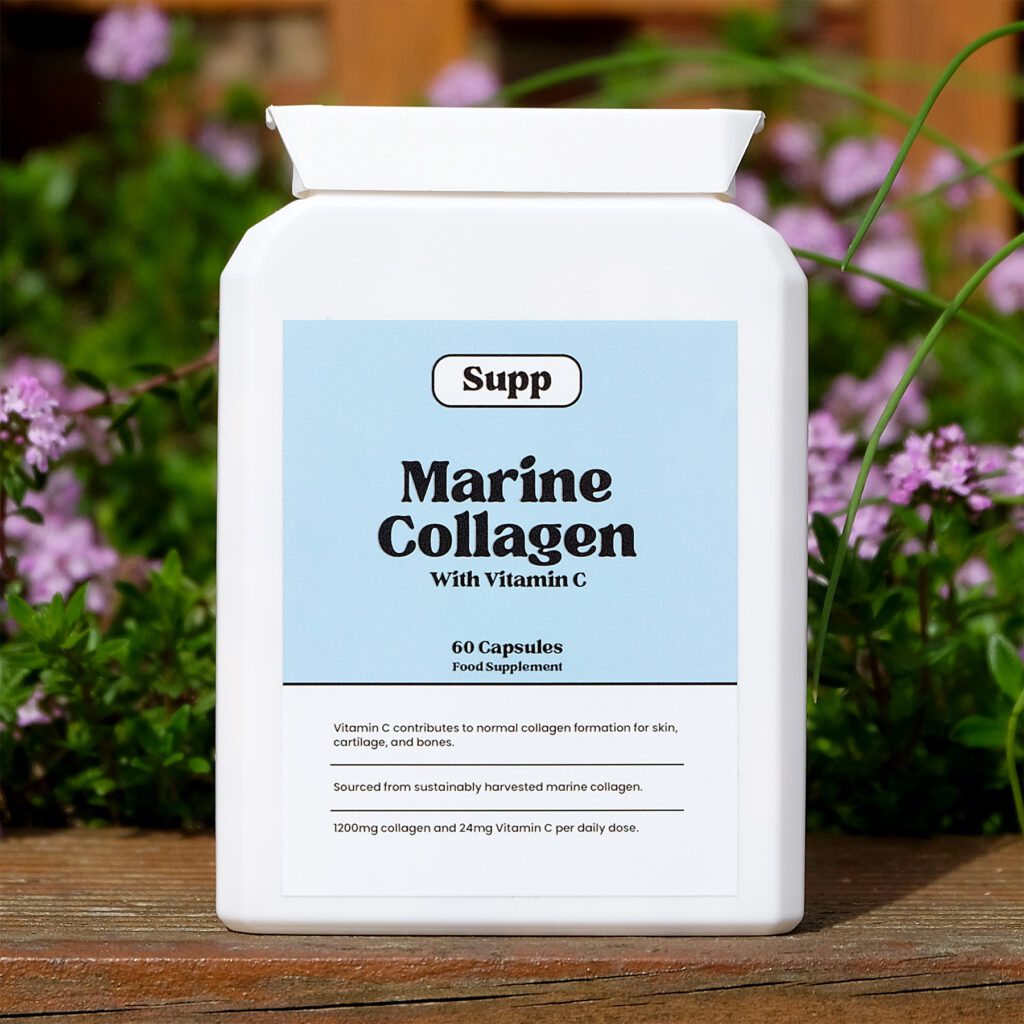
If you’re comparing products, here’s an example of a Marine Collagen supplement that follows the principles above: Supp’s Marine Collagen Capsules.
We use hydrolysed marine collagen peptides, include vitamin C, and are made to GMP standards with a short, purpose-driven ingredient list.
How Long Does Marine Collagen Take To Work?
Most skin-focused studies run for 8 to 12 weeks, with consistent daily use.
This timeframe aligns with the skin’s natural renewal cycle, which slows as we get older, helping explain why changes tend to appear gradually rather than immediately.
That does not mean everyone will notice changes at the same pace, but it’s a reasonable timeframe to set expectations.
Takeaways
Marine collagen is a fish-derived source of collagen, most commonly provided as hydrolysed peptides. The strongest human evidence relates to skin hydration and elasticity, with more mixed evidence for joint comfort depending on the type and form used.
Absorption depends more on how collagen is processed than where it comes from, and pairing collagen with vitamin C makes sense due to vitamin C’s established role in normal collagen formation.
As with most supplements, quality, sourcing, and formulation matter more than bold claims. A well-made product should be transparent about its ingredients, standards, and purpose, and fit sensibly into a balanced diet and healthy lifestyle.
References:
- Kim D-U, Chung H-C, Choi J, Sakai Y, Lee B-Y. 2018. Oral Intake of Low-Molecular-Weight Collagen Peptide Improves Hydration, Elasticity, and Wrinkling in Human Skin. Nutrients. https://pubmed.ncbi.nlm.nih.gov/29949889/
- Pu S-Y, Huang Y-L, Pu C-M, et al. 2023. Effects of Oral Collagen for Skin Anti-Aging: A Systematic Review and Meta-Analysis. Nutrients. https://pubmed.ncbi.nlm.nih.gov/37432180/
- Myung S-K, Park Y. 2025. Effects of Collagen Supplements on Skin Aging: A Systematic Review and Meta-Analysis of Randomized Controlled Trials. The American Journal of Medicine. https://pubmed.ncbi.nlm.nih.gov/40324552/
- García-Coronado JM, Martínez-Olvera L, Elizondo-Omaña RE, et al. 2019. Effect of collagen supplementation on osteoarthritis symptoms: a meta-analysis of randomized placebo-controlled trials. International Orthopaedics. https://pubmed.ncbi.nlm.nih.gov/30368550/
Discliamer:
This article is for general information only and is not intended as medical advice. If you have any health conditions or are taking medication, speak to a healthcare professional before using supplements.