


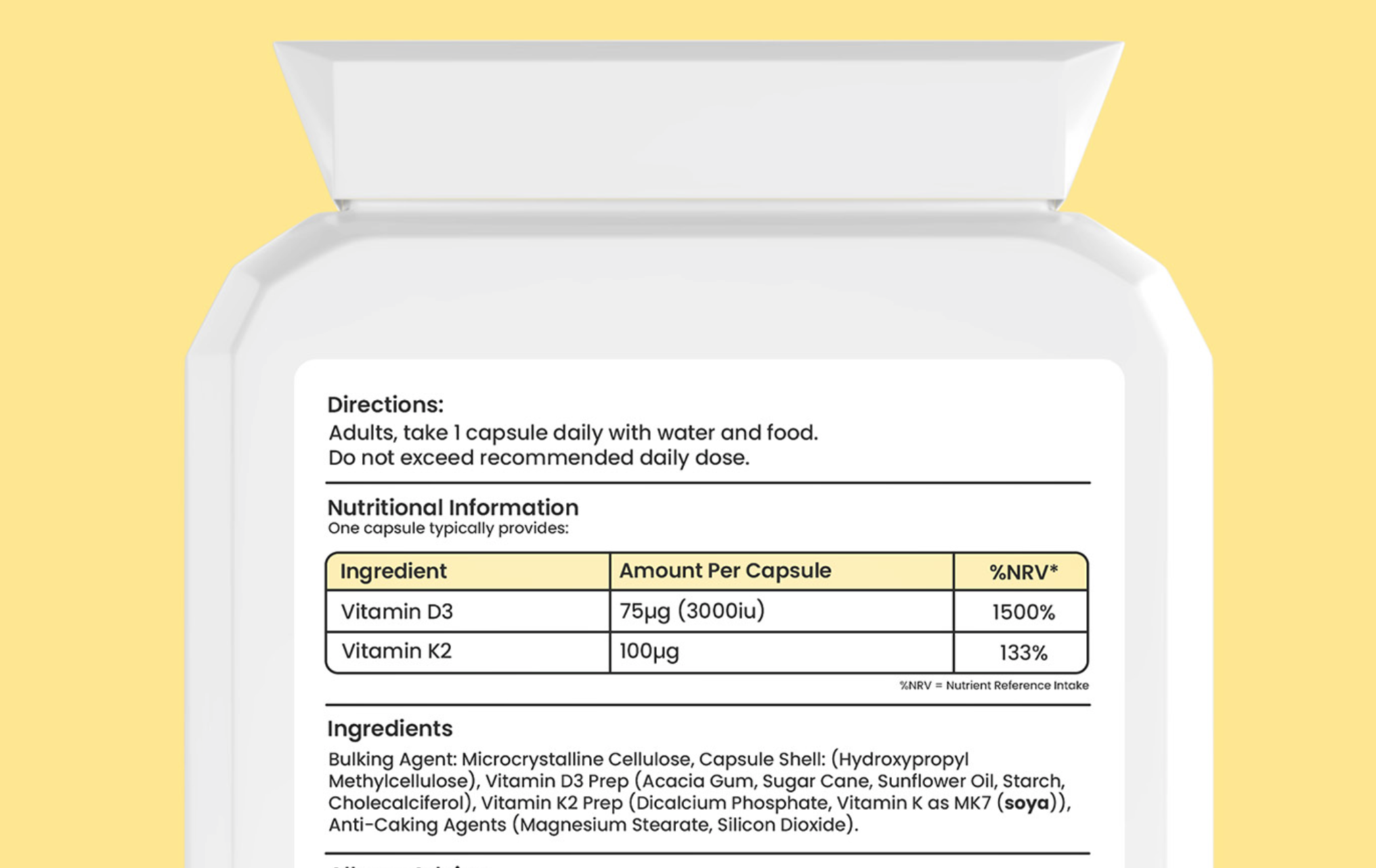
If you’ve ever looked at a supplement label and thought, “Why is this 300%?” or “Is 10,000% even safe?” you’re not alone.
Nutrient Reference Values (NRVs) are one of the most misunderstood parts of supplement labelling. They’re often treated as targets, limits, or even warnings, when in reality they’re none of those things.
In this guide, we’ll explain what NRVs actually are, why some nutrients appear at very high percentages, why others don’t have NRVs at all, and how to use them properly when choosing supplements.
What Are Nutrient Reference Values (NRVs)?
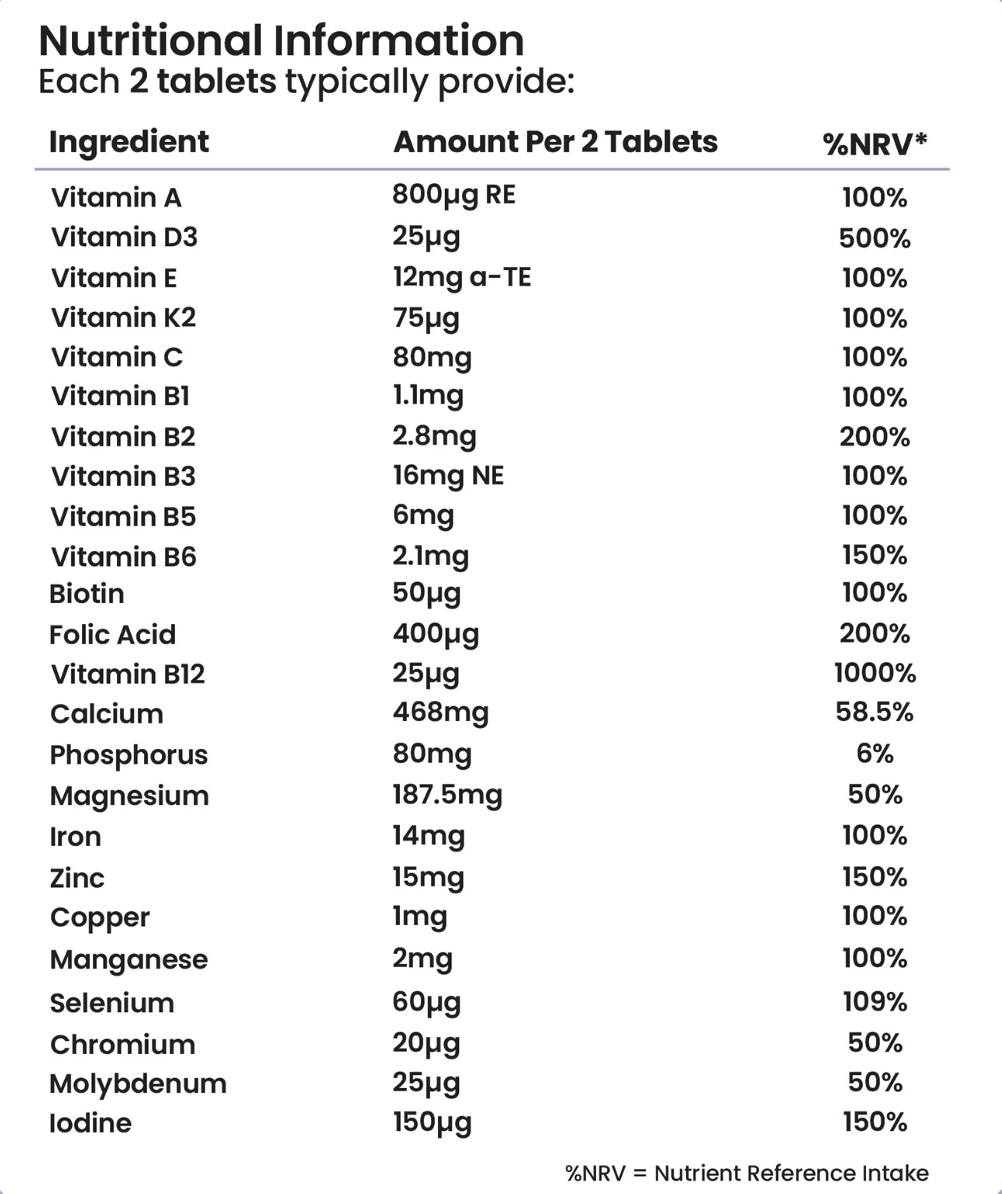
Nutrient Reference Values, or NRVs, are guideline amounts set by UK and EU regulators to help standardise nutrition labelling.
They represent the average daily amount of a vitamin or mineral needed to prevent deficiency in a generally healthy adult.
NRVs are primarily designed for:
- Food and supplement labelling
- Helping consumers compare products
- Ensuring consistency across packaging
They are not personalised, and they are not designed to reflect optimal health, performance, or specific goals.
Think of NRVs as a reference point, not a prescription.
What NRVs Are Not
This is where most confusion starts.
NRVs are NOT:
- A personalised daily requirement
- An “ideal” intake for everyone
- A safety limit
- A recommendation for therapeutic use
- A measure of how effective a supplement will be
They don’t account for:
- Your diet
- Your lifestyle or stress levels
- Absorption differences
- Existing deficiencies
- Age, sex, or activity levels
- Whether a nutrient is being used for a specific purpose
In other words, NRVs are a baseline, not a goal.
You Don’t Get All Your Nutrients From Supplements
One important point that often gets missed: NRVs assume nutrients come from food as well as supplements.
Most people get a portion of their daily vitamins and minerals from:
- Fruits and vegetables
- Grains and legumes
- Meat, fish, eggs, or dairy
- Fortified foods
So if a supplement provides less than 100% NRV for certain vitamins or minerals, that isn’t automatically a problem. It may be designed to top up dietary intake, not replace it entirely.
On the flip side, when a supplement is formulated to support a specific outcome rather than general nutrition, higher doses may be used intentionally.
Why Some Supplements Have NRVs and Others Don’t
You may have noticed that some products list NRVs, while others don’t show percentages at all.
This is completely normal.
NRVs exist mainly for:
- Vitamins
- Minerals
They do not exist for many other commonly used supplement ingredients, including:
- Botanical extracts
- Herbs
- Mushrooms
- Amino acids
- Functional compounds like collagen or D-mannose
Why? Because NRVs are based on preventing deficiency states. Many of the ingredients above:
- Are not classified as essential nutrients
- Don’t have a recognised deficiency level
- Are studied using specific dose ranges rather than daily minimums
So if a product doesn’t list an NRV, it doesn’t mean the ingredient is unimportant or unregulated. It simply means an NRV hasn’t been established.
Why Some NRV Percentages Look Extremely High
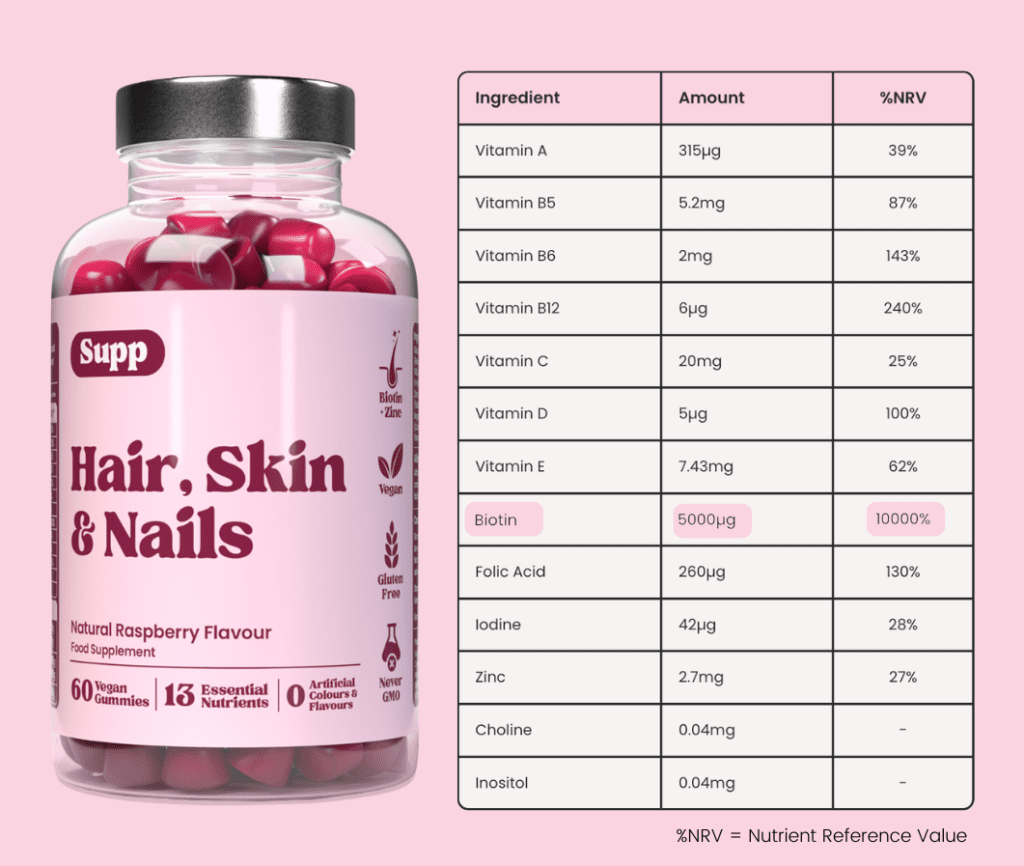
This is one of the biggest causes of concern for customers, especially with nutrients like biotin.
You might see a label showing:
- 5,000 µg biotin
- 10,000% NRV
At first glance, that looks alarming. But here’s the context.
Biotin’s NRV is set very low because true deficiency is rare. The NRV reflects minimum needs, not amounts studied for specific uses like hair, skin, or nail support.
When higher doses are used in supplements, it’s usually because:
- Research uses higher intake levels
- The nutrient is being included for a targeted purpose
- Individual absorption varies
- The aim is support beyond basic deficiency prevention
So a high NRV percentage doesn’t automatically mean a dose is excessive or unsafe. It means the dose goes beyond the baseline reference amount.
Are High NRV Percentages Safe?
NRVs should not be confused with safety limits.
For some nutrients, regulatory bodies also set Tolerable Upper Intake Levels (ULs). These indicate the highest daily intake unlikely to cause harm in the general population.
Importantly:
- NRVs are not upper limits
- Exceeding 100% NRV does not mean you’re exceeding safe intake
- Safety depends on the nutrient, the dose, and total daily intake from all sources
Many vitamins, particularly water-soluble ones, are handled differently by the body than fat-soluble vitamins, which is why context matters far more than percentages alone.
Why B Vitamins Often Show Very High NRVs
B vitamins are a common source of confusion on supplement labels.
They often appear at:
- 200%
- 400%
- 1,000% NRV or more
There are a few reasons for this. B vitamins:
- Are water-soluble
- Play key roles in energy metabolism and nervous system function
- Are involved in processes that increase under stress
- Are commonly included at higher levels in research and clinical settings
Higher doses are often used to support:
- Energy metabolism
- Mental performance
- Reduction of tiredness and fatigue
- Busy or demanding lifestyles
Because they aren’t stored long-term in the body in the same way as fat-soluble vitamins, formulations often include amounts well above the NRV for functional support rather than deficiency prevention.
When NRVs Are Actually Useful
Despite the confusion, NRVs do have a place.
They’re useful for:
- Comparing similar products
- Spotting very low or token doses
- Understanding how much a supplement contributes to daily intake
- Avoiding accidental stacking across multiple products
They’re most helpful when used alongside ingredient amounts and purpose, not on their own.
How We Use NRVs at Supp
At Supp, we see NRVs as a tool for context, not a target to hit for the sake of it.
Our approach is simple:
- NRVs help explain where a nutrient sits in relation to baseline needs
- Dosages are informed by research and real-world use, not just percentages
- We don’t cap ingredients at 100% NRV if evidence suggests a higher amount is appropriate
- We label clearly so you can make informed decisions
Some formulas are designed to complement dietary intake. Others are built to support a specific outcome. The dosage reflects that purpose.
How to Read Supplement Labels Without Overthinking It
If there’s one takeaway from all of this, it’s this:
Don’t judge a supplement by the NRV percentage alone.
Instead:
- Look at the actual dose
- Ask what the ingredient is included for, not just how much of it is there
- Check whether an NRV even exists for that ingredient
- Consider what you already get from food
- Think about your own lifestyle and needs
At Supp, we know this information isn’t always obvious at a glance. That’s why on every product page we explain why each ingredient is included, what role it plays in the formula, and how it fits the overall purpose of the supplement.
For those who want to go deeper, we also break ingredients down individually in our Ingredients Library, where we explain what each ingredient is, how it’s used, and the context behind typical dosages. That way, you’re not just seeing numbers on a label, you’re seeing the reasoning behind them.
NRVs are a reference point. Understanding the context is what really matters.
The Bottom Line on NRVs
Nutrient Reference Values were created to help, not to confuse.
They’re useful for orientation, but they don’t define quality, effectiveness, or safety on their own. High percentages aren’t automatically bad. Lower percentages aren’t automatically pointless.
The best supplements explain why an ingredient is there, not just how close it gets to 100%.
That’s the standard we believe in.
Disclaimer:
This article is for general information only and does not replace personalised nutrition or medical advice.