




If you’ve been reading about D-Mannose and are close to giving it a try, you’ve probably got a few questions before you buy, such as – Is it safe? Are there side effects? How much should you take?
These are exactly the right things to ask. And the honest answer, for most people, is reassuring. D-Mannose has a well-established safety profile and is generally considered one of the better-tolerated supplements available for urinary tract health support.
There are, however, a small number of groups who should approach with more caution, and it’s worth knowing who they are before you start.
This guide covers everything you need to know: what the research says about safety, what side effects have been reported, how to dose it sensibly, and when it is worth checking with your GP first.
What Is D-Mannose
D-Mannose is a naturally occurring simple sugar found in fruits like cranberries, blueberries, and peaches. It’s also produced in small amounts by the human body.
When taken as a supplement, it passes through the gut, enters the bloodstream, and is filtered out through the kidneys into the urine. This is what makes it useful for urinary tract health.
The leading theory is that D-Mannose works by binding to the same receptors on the bladder lining that certain bacteria (most commonly E. coli) use to attach and take hold. With those receptors occupied, the bacteria are more likely to be flushed out with urine rather than sticking around to cause problems [1].
For a deeper look at how D-Mannose works, see our guide: What Is D-Mannose and How Does It Support Urinary Health?
Is D-Mannose Safe?
For healthy adults, yes. D-Mannose is considered safe, and this is backed by clinical evidence:
One meta-analysis reviewed multiple studies on D-Mannose use in adult women and concluded that it appears well tolerated, with only a small percentage of participants reporting any side effects at all [2].
A randomised clinical trial involving 308 women, who took 2g of D-Mannose daily for six months, found that side effects were mild and did not require anyone to stop taking it [3]. Six months is a substantial period of consistent use, and the dropout rate due to side effects was negligible.
D-Mannose isn’t metabolised by the body in the same way as regular sugar (glucose). Rather than being stored or used for energy, it’s largely filtered out through the kidneys and excreted in urine. This means it doesn’t behave like the added sugar you might find in a soft drink, and it doesn’t cause the same kind of blood sugar spike [4].
Does D-Mannose Cause Any Side Effects?
Side effects from D-Mannose are uncommon and, where they do occur, tend to be mild and digestive in nature.
One of the very few reported side effects is loose stools or diarrhoea. In one of the largest clinical trials to date, only 8 out of 103 participants (around 8%) taking 2g of D-Mannose daily reported diarrhoea over six months [3]. The majority experienced no side effects at all.
Other mild digestive effects, such as bloating, have occasionally been noted, especially at higher doses than those typically recommended for daily maintenance.
No serious adverse effects have been identified in clinical trials at recommended doses.
There has been one documented case report of a rare immune reaction in a person taking a D-Mannose-containing product [5]. This type of reaction, known as a serum sickness-like response, is a delayed immune reaction that can cause a rash and joint discomfort. It’s considered very unusual and is not a recognised pattern across the wider research. It’s included here for transparency, because we believe you deserve the complete picture.
As with any supplement, if you notice an unexpected reaction after starting D-Mannose, stop taking it and speak to your GP.
Who Should Be Cautious With D-Mannose?
For most healthy adults, D-Mannose is suitable as part of a daily routine. There are, however, a few groups who should take extra care or seek medical advice first.
If you have diabetes:
Because D-Mannose is a type of sugar, people with diabetes are advised to check with their doctor before taking it. Research has found a clear correlation between fasting plasma mannose levels and fasting plasma glucose levels in both healthy and diabetic subjects, with mannose concentrations closely tracking blood glucose [4]. I
Simply put, mannose and glucose behave in a related way in the body, and that relationship is more pronounced in people whose blood sugar regulation is already affected.
While a short-term clinical study found that oral mannose administration did not negatively affect glucose tolerance in non-diabetic individuals [6], the evidence in people with existing diabetes is not yet conclusive enough to make a blanket recommendation.
If you have well-managed diabetes and want to explore D-Mannose, a conversation with your GP or diabetes team is the sensible first step.
If you are pregnant or breastfeeding
Animal model research has raised questions about mannose exposure during early foetal development. Human-specific clinical data on D-Mannose supplementation during pregnancy remains very limited. The general guidance is to avoid supplementation during this period unless directed otherwise by a healthcare professional.
If you have kidney disease
Because D-Mannose is filtered through the kidneys, anyone with known kidney problems should speak to a doctor before taking it. Elevated circulating mannose levels have been associated with altered urinary protein excretion in individuals with renal conditions [4], and normal-dose supplementation has not been adequately studied in this group.
D-Mannose Dosage: What Does The Evidence Suggest?
Dosage guidance varies slightly between studies, but the research points to a few consistent patterns.
For urinary tract health support as part of a daily routine, studies have typically used 2g per day [3, 7]. This is the dose used across several clinical trials and is the most widely referenced figure in the research.
For acute urinary discomfort, some clinical protocols suggest taking a dose every 2 to 3 hours during the period of discomfort, before switching to a lower maintenance dose once symptoms ease [3].
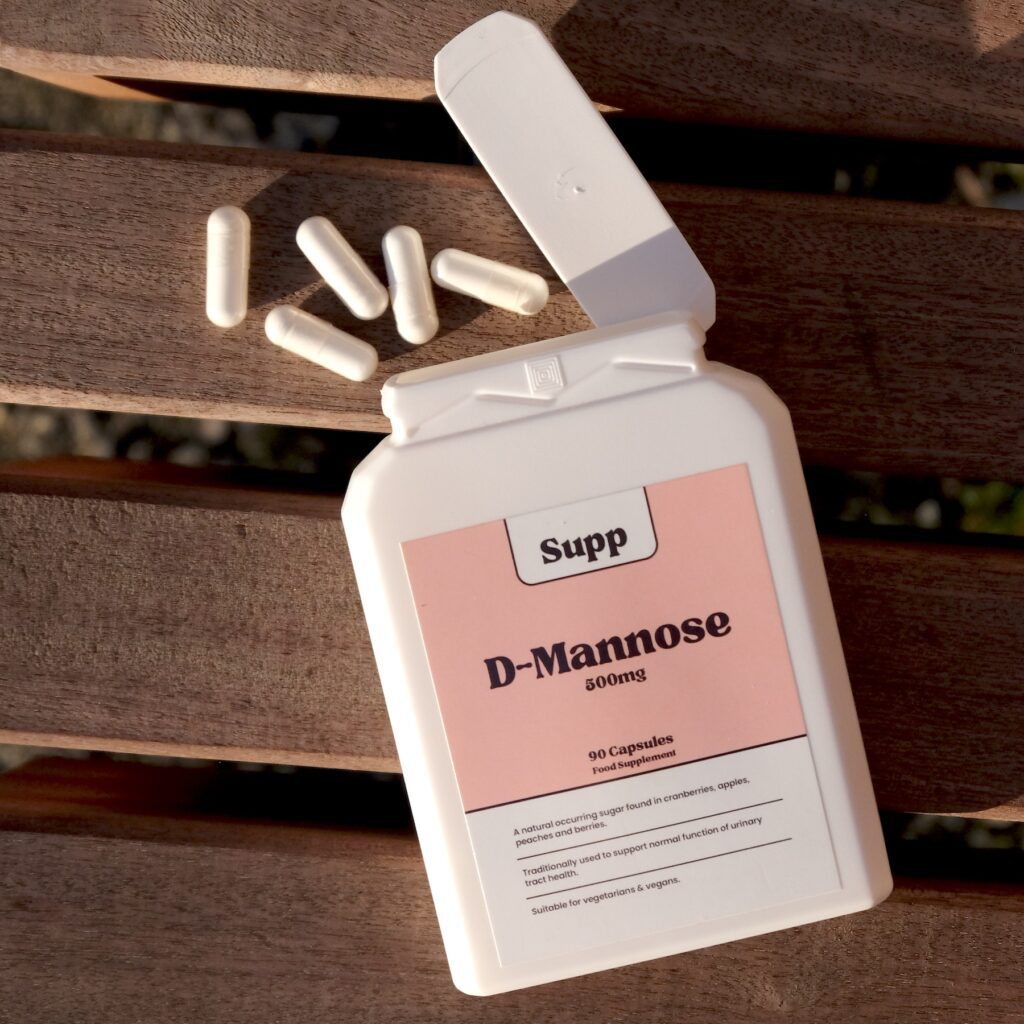
Our D-Mannose capsules provide 500mg of D-Mannose per capsule, which is intentional. Rather than locking you into one fixed dose, it gives you genuine flexibility to find what works for your body and your routine. That flexibility also matters if you want to ease in gently. Some people prefer to start low and increase gradually, particularly if they have a sensitive stomach.
As always, our capsules are made in the UK, GMP certified, and contain no hidden blends or unnecessary fillers. The label tells you exactly what is inside.
A note on timing: D-Mannose doesn’t need to be taken with food, though some people find it easier on the stomach when they do. Consistency matters more than timing. If you find it hard to build new supplements into your day, our guide on building healthy habits that stick is worth a read.
When To See A GP
D-Mannose is a supplement. It supports urinary tract health as part of a healthy daily routine. It’s not a treatment for infection, and it is not a substitute for medical care when that care is needed.
If you’re experiencing symptoms of a urinary tract infection (burning when urinating, frequent urge to go, pain in the lower abdomen, fever, or blood in urine), please see a GP or healthcare professional.
Similarly, if symptoms return repeatedly despite making lifestyle changes and supporting your routine with supplements like D-Mannose, that’s worth investigating with your doctor. Recurring UTIs can sometimes point to an underlying factor that deserves proper assessment and medical intervention.
Final Takeaways
D-Mannose is well-tolerated and considered safe for most healthy adults. The most commonly reported side effect is mild digestive discomfort, which affects a small minority of users and typically does not require stopping use.
If you have diabetes, are pregnant or breastfeeding, or have kidney concerns, please check with your GP before starting any D-Mannose supplement.
Find Out More About Our D-Mannose 500mg Capsules Here
References
- Bouckaert J, Berglund J, Schembri M, et al. 2005. Receptor binding studies disclose a novel class of high-affinity inhibitors of the Escherichia coli FimH adhesin. Molecular Microbiology. https://pubmed.ncbi.nlm.nih.gov/16313611/
- Lenger SM, Bradley MS, Thomas DA, Bertolet MH, Lowder JL, Sutcliffe S. 2020. D-mannose vs other agents for recurrent urinary tract infection prevention in adult women: a systematic review and meta-analysis. American Journal of Obstetrics and Gynecology. https://pubmed.ncbi.nlm.nih.gov/32497610/
- Kranjcec B, Papes D, Altarac S. 2014. D-mannose powder for prophylaxis of recurrent urinary tract infections in women: a randomized clinical trial. World Journal of Urology. https://pubmed.ncbi.nlm.nih.gov/23633128/
- Pitkänen E. 2001. Metabolic syndrome is associated with changes in D-mannose metabolism. Clinica Chimica Acta. https://pubmed.ncbi.nlm.nih.gov/10691051/
- Scott C, Stein B. 2024. Serum sickness-like reaction to D-mannose supplement: a case report. PMC. https://pmc.ncbi.nlm.nih.gov/articles/PMC11193288/
- Ferrannini E, Bokarewa M, Brembeck P, et al. 2020. Mannose is an insulin-regulated metabolite reflecting whole-body insulin sensitivity in man. Metabolism. https://pubmed.ncbi.nlm.nih.gov/31682799/
- Sharma V, Phé V, Pakzad M, Curtis C, et al. 2024. D-mannose for prevention of recurrent urinary tract infection among women: a randomized clinical trial. JAMA Internal Medicine. https://pubmed.ncbi.nlm.nih.gov/38587819/
Disclaimer:
This article is intended for general informational purposes only and does not constitute medical advice. The information provided is not a substitute for professional medical guidance, diagnosis, or treatment. If you have an existing health condition, are pregnant or breastfeeding, or are taking any medication, please consult your GP or a qualified healthcare professional before starting any new supplement. If you are experiencing symptoms of a urinary tract infection, seek medical advice promptly.
0 Comments